Commvault is monitoring cyber threat activity targeting their applications hosted in their Microsoft Azure cloud environment. Threat actors may have accessed client secrets for Commvault’s (Metallic) Microsoft 365 (M365) backup software-as-a-service (SaaS) solution, hosted in Azure. This provided the threat actors with unauthorized access to Commvault’s customers’ M365 environments that have application secrets stored by Commvault.
CISA believes the threat activity may be part of a larger campaign targeting various SaaS companies’ cloud applications with default configurations and elevated permissions.
CISA urges users and administrators to review the following mitigations and apply necessary patches and updates for all systems:
Monitor Entra audit logs for unauthorized modifications or additions of credentials to service principals initiated by Commvault applications/service principals.
Handle deviations from regular login schedules as suspicious.
Review Microsoft logs (Entra audit, Entra sign-in, unified audit logs) and conduct internal threat hunting in alignment with documented organizational incident response polices.
(Applies to single tenant apps only) Implement a conditional access policy that limits authentication of an application service principal to an approved IP address that is listed within Commvault’s allowlisted range of IP addresses.
Note: A Microsoft Entra Workload ID Premium License is required to apply conditional access policies to an application service principal and is available to customers at an additional cost.[1]
For certain Commvault customers, rotate their application secrets, rotate those credentials on Commvault Metallic applications and service principles available between February and May 2025.[2] Note: This mitigation only applies to a limited number of customers who themselves have control over Commvault’s application secrets.
Customers who have the ability to, if applicable, should establish a policy to regularly rotate credentials at least every 30 days.
Review the list of Application Registrations and Service Principals in Entra with administrative consent for higher privileges than the business need.
Precautionary Recommendations for On-premises Software Versions
Where technically feasible, restrict access to Commvault management interfaces to trusted networks and administrative systems.
Detect and block path-traversal attempts and suspicious file uploads by deploying a Web Application Firewall and removing external access to Commvault applications [CSA-250502].
Apply the patches provided [3] and follow these best practices [4].
Especially monitor activity from unexpected directories, particularly web-accessible paths.
CVE-2025-4632 Samsung MagicINFO 9 Server Path Traversal Vulnerability
These types of vulnerabilities are frequent attack vectors for malicious cyber actors and pose significant risks to the federal enterprise.
Binding Operational Directive (BOD) 22-01: Reducing the Significant Risk of Known Exploited Vulnerabilities established the Known Exploited Vulnerabilities Catalog as a living list of known Common Vulnerabilities and Exposures (CVEs) that carry significant risk to the federal enterprise. BOD 22-01 requires Federal Civilian Executive Branch (FCEB) agencies to remediate identified vulnerabilities by the due date to protect FCEB networks against active threats. See the BOD 22-01 Fact Sheet for more information.
Although BOD 22-01 only applies to FCEB agencies, CISA strongly urges all organizations to reduce their exposure to cyberattacks by prioritizing timely remediation of Catalog vulnerabilities as part of their vulnerability management practice. CISA will continue to add vulnerabilities to the catalog that meet the specified criteria.
CISA released two Industrial Control Systems (ICS) advisories on May 22, 2025. These advisories provide timely information about current security issues, vulnerabilities, and exploits surrounding ICS.
Lantronix Device installer is vulnerable to XML External Entity (XXE) attacks in configuration files read from the network device. An attacker could obtain credentials, access these network devices, and modify their configurations. An attacker may also gain access to the host running the Device Installer software or the password hash of the user running the application.
CRITICAL INFRASTRUCTURE SECTORS: Information Technology
COUNTRIES/AREAS DEPLOYED: Worldwide
COMPANY HEADQUARTERS LOCATION: United States
3.4 RESEARCHER
Robert McLellan reported this vulnerability to CISA.
4. MITIGATIONS
Lantronix indicates its Device Installer product has reached its end of support lifecycle in 2018. It will not receive any additional updates or security enhancements. For your security, Lantronix advises migrating to a supported solution Lantronix Provisioning Manager as soon as possible. Using unsupported software is at user's own discretion and may leave user systems vulnerable to security issues.
CISA recommends users take defensive measures to minimize the risk of exploitation of this vulnerability such as:
Locate control system networks and remote devices behind firewalls and isolating them from business networks.
When remote access is required, use more secure methods, such as Virtual Private Networks (VPNs), recognizing VPNs may have vulnerabilities and should be updated to the most current version available. Also recognize VPN is only as secure as the connected devices.
CISA reminds organizations to perform proper impact analysis and risk assessment prior to deploying defensive measures.
Organizations observing suspected malicious activity should follow established internal procedures and report findings to CISA for tracking and correlation against other incidents.
CISA also recommends users take the following measures to protect themselves from social engineering attacks:
Do not click web links or open attachments in unsolicited email messages.
No known public exploitation specifically targeting this vulnerability has been reported to CISA at this time. This vulnerability is not exploitable remotely.
This information sheet highlights the critical role of data security in ensuring the accuracy, integrity, and trustworthiness of AI outcomes. It outlines key risks that may arise from data security and integrity issues across all phases of the AI lifecycle, from development and testing to deployment and operation.
Defense Industrial Bases, National Security Systems owners, federal agencies, and Critical Infrastructure owners and operators are encouraged to review this information sheet and implement the recommended best practices and mitigation strategies to protect sensitive, proprietary, and mission critical data in AI-enabled and machine learning systems. These include adopting robust data protection measures; proactively managing risks; and strengthening monitoring, threat detection, and network defense capabilities.
As AI systems become more integrated into essential operations, organizations must remain vigilant and take deliberate steps to secure the data that powers them. For more information on securing AI data, see CISA’s Artificial Intelligence webpage.
Vulnerability: Improper Restriction of XML External Entity Reference
2. RISK EVALUATION
Successful exploitation of this vulnerability could allow an attacker to launch XXE-based attacks on applications that accept malicious log4net configuration files.
3. TECHNICAL DETAILS
3.1 AFFECTED PRODUCTS
The following versions of Rockwell Automation FactoryTalk Historian ThingWorx are affected:
Apache log4net versions before 2.0.10 do not disable XML external entities when parsing log4net configuration files. This allows for XXE-based attacks in applications that accept attacker-controlled log4net configuration files.
Rockwell Automation reported this vulnerability to CISA.
4. MITIGATIONS
Rockwell Automation released a product update addressing this vulnerability:
95057C-FTHTWXCT11: Versions v5.00.00 and later
For information on how to mitigate security risks on industrial automation control systems, Rockwell Automation encourages users to implement their suggested security best practices to minimize the risk of the vulnerability.
Locate control system networks and remote devices behind firewalls and isolating them from business networks.
When remote access is required, use more secure methods, such as Virtual Private Networks (VPNs), recognizing VPNs may have vulnerabilities and should be updated to the most current version available. Also recognize VPN is only as secure as the connected devices.
CISA reminds organizations to perform proper impact analysis and risk assessment prior to deploying defensive measures.
Organizations observing suspected malicious activity should follow established internal procedures and report findings to CISA for tracking and correlation against other incidents.
CISA also recommends users take the following measures to protect themselves from social engineering attacks:
Do not click web links or open attachments in unsolicited email messages.
This advisory details a Russian state-sponsored cyber espionage-oriented campaign targeting technology companies and logistics entities, including those involved in the coordination, transport, and delivery of foreign assistance to Ukraine.
Russian General Staff Main Intelligence Directorate (GRU) 85th Main Special Service Center, military unit 26165 cyber actors are using a mix of previously disclosed tactics, techniques, and procedures (TTPs) and are likely connected to these actors’ widescale targeting of IP cameras in Ukraine and bordering NATO nations.
Executives and network defenders at logistics entities and technology companies should recognize the elevated threat of until 26165 targeting, increase monitoring and threat hunting for known TTPs and indicators of compromise, and posture network defenses with a presumption of targeting. For more information on Russian state-sponsored threat actor activity, see CISA’s Russia Cyber Threat Overview and Advisories page.
This joint cybersecurity advisory (CSA) highlights a Russian state-sponsored cyber campaign targeting Western logistics entities and technology companies. This includes those involved in the coordination, transport, and delivery of foreign assistance to Ukraine. Since 2022, Western logistics entities and IT companies have faced an elevated risk of targeting by the Russian General Staff Main Intelligence Directorate (GRU) 85th Main Special Service Center (85th GTsSS), military unit 26165—tracked in the cybersecurity community under several names (see “Cybersecurity Industry Tracking”). The actors’ cyber espionage-oriented campaign, targeting technology companies and logistics entities, uses a mix of previously disclosed tactics, techniques, and procedures (TTPs). The authoring agencies expect similar targeting and TTP use to continue.
Executives and network defenders at logistics entities and technology companies should recognize the elevated threat of unit 26165 targeting, increase monitoring and threat hunting for known TTPs and indicators of compromise (IOCs), and posture network defenses with a presumption of targeting.
This cyber espionage-oriented campaign targeting logistics entities and technology companies uses a mix of previously disclosed TTPs and is likely connected to these actors’ wide scale targeting of IP cameras in Ukraine and bordering NATO nations.
The following authors and co-sealers are releasing this CSA:
United States National Security Agency (NSA)
United States Federal Bureau of Investigation (FBI)
United Kingdom National Cyber Security Centre (NCSC-UK)
Germany Federal Intelligence Service (BND) Bundesnachrichtendienst
Germany Federal Office for Information Security (BSI) Bundesamt für Sicherheit in der Informationstechnik
Germany Federal Office for the Protection of the Constitution (BfV) Bundesamt für Verfassungsschutz
Czech Republic Military Intelligence (VZ) Vojenské zpravodajství
Czech Republic National Cyber and Information Security Agency (NÚKIB) Národní úřad pro kybernetickou a informační bezpečnost
Czech Republic Security Information Service (BIS) Bezpečnostní informační služba
Poland Internal Security Agency (ABW) Agencja Bezpieczeństwa Wewnętrznego
Poland Military Counterintelligence Service (SKW) Służba Kontrwywiadu Wojskowego
United States Cybersecurity and Infrastructure Security Agency (CISA)
United States Department of Defense Cyber Crime Center (DC3)
United States Cyber Command (USCYBERCOM)
Australian Signals Directorate’s Australian Cyber Security Centre (ASD’s ACSC)
Canadian Centre for Cyber Security (CCCS)
Danish Defence Intelligence Service (DDIS) Forsvarets Efterretningstjeneste
Estonian Foreign Intelligence Service (EFIS) Välisluureamet
Estonian National Cyber Security Centre (NCSC-EE) Küberturvalisuse keskus
French Cybersecurity Agency (ANSSI) Agence nationale de la sécurité des systèmes d'information
Netherlands Defence Intelligence and Security Service (MIVD) Militaire Inlichtingen- en Veiligheidsdienst
For over two years, the Russian GRU 85th GTsSS, military unit 26165—commonly known in the cybersecurity community as APT28, Fancy Bear, Forest Blizzard, BlueDelta, and a variety of other identifiers—has conducted this campaign using a mix of known tactics, techniques, and procedures (TTPs), including reconstituted password spraying capabilities, spearphishing, and modification of Microsoft Exchange mailbox permissions. In late February 2022, multiple Russian state-sponsored cyber actors increased the variety of cyber operations for purposes of espionage, destruction, and influence—with unit 26165 predominately involved in espionage. [1] As Russian military forces failed to meet their military objectives and Western countries provided aid to support Ukraine’s territorial defense, unit 26165 expanded its targeting of logistics entities and technology companies involved in the delivery of aid. These actors have also targeted Internet-connected cameras at Ukrainian border crossings to monitor and track aid shipments. Note: This advisory uses the MITRE ATT&CK® for Enterprise framework, version 17. See Appendix A: MITRE ATT&CK tactics and techniques for a table of the threat actors’ activity mapped to MITRE ATT&CK tactics and techniques. This advisory uses the MITRE D3FEND® framework, version 1.0.
Description of Targets
The GRU unit 26165 cyber campaign against Western logistics providers and technology companies has targeted dozens of entities, including government organizations and private/commercial entities across virtually all transportation modes: air, sea, and rail. These actors have targeted entities associated with the following verticals within NATO member states, Ukraine, and at international organizations:
Defense Industry
Transportation and Transportation Hubs (ports, airports, etc.)
Maritime
Air Traffic Management
IT Services
In the course of the targeting lifecycle, unit 26165 actors identified and conducted follow-on targeting of additional entities in the transportation sector that had business ties to the primary target, exploiting trust relationships to attempt to gain additional access [T1199].
The actors also conducted reconnaissance on at least one entity involved in the production of industrial control system (ICS) components for railway management, though a successful compromise was not confirmed [TA0043].
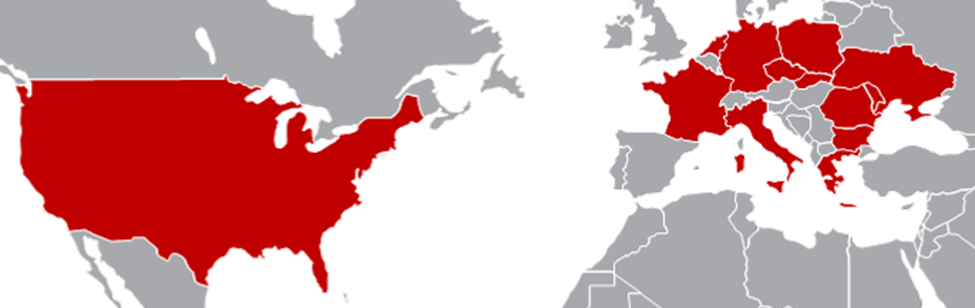
The countries with targeted entities include the following, as illustrated in Figure 1:
Bulgaria
Czech Republic
France
Germany
Greece
Italy
Moldova
Netherlands
Poland
Romania
Slovakia
Ukraine
United States
Figure 1: Countries with Targeted Entities
Initial Access TTPs
To gain initial access to targeted entities, unit 26165 actors used several techniques to gain initial access to targeted entities, including (but not limited to):
The actors abused vulnerabilities associated with a range of brands and models of small office/home office (SOHO) devices to facilitate covert cyber operations, as well as proxy malicious activity via devices with geolocation in proximity to the target [T1665]. [2]
Credential Guessing/Brute Force
Unit 26165 actors’ credential guessing [T1110.001] operations in this campaign exhibit some similar characteristics to those disclosed in the previous CSA “Russian GRU Conducting Global Brute Force Campaign to Compromise Enterprise and Cloud Environments.” [3] Based on victim network investigations, the current iteration of this TTP employs a similar blend of anonymization infrastructure, including the use of Tor and commercial VPNs [T1090.003]. The actors frequently rotated the IP addresses used to further hamper detection. All observed connections were made via encrypted TLS [T1573].
Spearphishing
GRU unit 26165 actors’ spearphishing emails included links [T1566.002] leading to fake login pages impersonating a variety of government entities and Western cloud email providers’ webpages. These webpages were typically hosted on free third-party services or compromised SOHO devices and often used legitimate documents associated with thematically similar entities as lures. The subjects of spearphishing emails were diverse and ranged from professional topics to adult themes. Phishing emails were frequently sent via compromised accounts or free webmail accounts [T1586.002, T1586.003]. The emails were typically written in the target’s native language and sent to a single targeted recipient.
Some campaigns employed multi-stage redirectors [T1104] verifying IP-geolocation [T1627.001] and browser fingerprints [T1627] to protect credential harvesting infrastructure or provide multifactor authentication (MFA) [T1111] and CAPTCHA relaying capabilities [T1056]. Connecting endpoints failing the location checks were redirected to a benign URL [T1627], such as msn.com. Redirector services used include:
Webhook[.]site
FrgeIO
InfinityFree
Dynu
Mocky
Pipedream
Mockbin[.]org
The actors also used spearphishing to deliver malware (including HEADLACE and MASEPIE) executables [T1204.002] delivered via third-party services and redirectors [T1566.002], scripts in a mix of languages [T1059] (including BAT [T1059.003] and VBScript [T1059.005]) and links to hosted shortcuts [T1204.001].
CVE Usage
Throughout this campaign, GRU unit 26165 weaponized an Outlook NTLM vulnerability (CVE-2023-23397) to collect NTLM hashes and credentials via specially crafted Outlook calendar appointment invitations [T1187]. [4],[5] These actors also used a series of Roundcube CVEs (CVE-2020-12641, CVE-2020-35730, and CVE-2021-44026) to execute arbitrary shell commands [T1059], gain access to victim email accounts, and retrieve sensitive data from email servers [T1114].
Since at least fall 2023, the actors leveraged a WinRAR vulnerability (CVE-2023-38831) allowing for the execution of arbitrary code embedded in an archive as a means of initial access [T1659]. The actors sent emails with malicious attachments [T1566.001] or embedded hyperlinks [T1566.002] that downloaded a malicious archive prepared using this CVE.
Post-Compromise TTPs
After an initial compromise using one of the above techniques, unit 26165 actors conducted contact information reconnaissance to identify additional targets in key positions [T1589.002]. The actors also conducted reconnaissance of the cybersecurity department [T1591], individuals responsible for coordinating transport [T1591.004], and other companies cooperating with the victim entity [T1591.002].
The actors used native commands and open source tools, such as Impacket and PsExec, to move laterally within the environment [TA0008]. Multiple Impacket scripts were used as .exe files, in addition to the python versions, depending on the victim environment. The actors also moved laterally within the network using Remote Desktop Protocol (RDP) [T1021.001] to access additional hosts and attempt to dump Active Directory NTDS.dit domain databases [T1003.003] using native Active Directory Domain Services commands, such as in Figure 2: Example Active Directory Domain Services command:
C:\Windows\system32\ntdsutil.exe "activate instance ntds" ifm "create full C:\temp\[a-z]{3}" quit quit
Figure 2: Example Active Directory Domain Services command
Additionally, GRU unit 26165 actors used the tools Certipy and ADExplorer.exe to exfiltrate information from the Active Directory. The actors installed python [T1059.006] on infected machines to enable the execution of Certipy. Accessed files were archived in .zip files prior to exfiltration [T1560]. The actors attempted to exfiltrate archived data via a previously dropped OpenSSH binary [T1048].
Incident response investigations revealed that the actors would take steps to locate and exfiltrate lists of Office 365 users and set up sustained email collection. The actors used manipulation of mailbox permissions [T1098.002] to establish sustained email collection at compromised logistics entities, as detailed in a Polish Cybercommand blog. [6]
After initial authentication, unit 26165 actors would change accounts' folder permissions and enroll compromised accounts in MFA mechanisms to increase the trust-level of compromised accounts and enable sustained access [T1556.006]. The actors leveraged python scripts to retrieve plaintext passwords via Group Policy Preferences [T1552.006] using Get-GPPPassword.py and a modified ldap-dump.py to enumerate the Windows environment [T1087.002] and conduct a brute force password spray [T1110.003] via Lightweight Directory Access Protocol (LDAP). The actors would additionally delete event logs through the wevtutil utility [T1070.001].
After gaining initial access to the network, the actors pursued further access to accounts with access to sensitive information on shipments, such as train schedules and shipping manifests. These accounts contained information on aid shipments to Ukraine, including:
sender,
recipient,
train/plane/ship numbers,
point of departure,
destination,
container registration numbers,
travel route, and
cargo contents.
In at least one instance, the actors attempted to use voice phishing [T1566.004] to gain access to privileged accounts by impersonating IT staff.
Malware
Unit 26165’s use of malware in this campaign ranged from gaining initial access to establishing persistence and exfiltrating data. In some cases, the attack chain resulted in multiple pieces of malware being deployed in succession. The actors used dynamic link library (DLL) search order hijacking [T1574.001] to facilitate malware execution. There were a number of known malware variants tied to this campaign against logistics sector victims, including:
While other malware variants, such as OCEANMAP and STEELHOOK, [8] were not directly observed targeting logistics or IT entities, their deployment against victims in other sectors in Ukraine and other Western countries suggest that they could be deployed against logistics and IT entities should the need arise.
Persistence
In addition to the abovementioned mailbox permissions abuse, unit 26165 actors also used scheduled tasks [T1053.005], run keys [T1547.001], and placed malicious shortcuts [T1547.009] in the startup folder to establish persistence.
Exfiltration
GRU unit 26165 actors used a variety of methods for data exfiltration that varied based on the victim environment, including both malware and living off the land binaries. PowerShell commands [T1059.001] were often used to prepare data for exfiltration; for example, the actors prepared zip archives [T1560.001] for upload to their own infrastructure.
The actors also used server data exchange protocols and Application Programming Interfaces (APIs) such as Exchange Web Services (EWS) and Internet Message Access Protocol (IMAP) [T1114.002] to exfiltrate data from email servers. In multiple instances, the actors used periodic EWS queries [T1119] to collect new emails sent and received since the last data exfiltration [T1029]. The actors typically used infrastructure in close geographic proximity to the victim. Long gaps between exfiltration, the use of trusted and legitimate protocols, and the use of local infrastructure allowed for long-term collection of sensitive data to go undetected.
Connections to Targeting of IP Cameras
In addition to targeting logistics entities, unit 26165 actors likely used access to private cameras at key locations, such as near border crossings, military installations, and rail stations, to track the movement of materials into Ukraine. The actors also used legitimate municipal services, such as traffic cams.
The actors targeted Real Time Streaming Protocol (RTSP) servers hosting IP cameras primarily located in Ukraine as early as March 2022 in a large-scale campaign, which included attempts to enumerate devices [T1592] and gain access to the cameras’ feeds [T1125]. Actor-controlled servers sent RTSP DESCRIBE requests destined for RTSP servers, primarily hosting IP cameras [T1090.002]. The DESCRIBE requests were crafted to obtain access to IP cameras located on logically distinct networks from that of the routers that received the request. The requests included Base64-encoded credentials for the RTSP server, which included publicly documented default credentials and likely generic attempts to brute force access to the devices [T1110]. An example of an RTSP request is shown in Figure 3.
Successful RTSP 200 OK responses contained a snapshot of the IP camera's image and IP camera metadata such as video codec, resolution, and other properties depending on the IP camera's configuration.
From a sample available to the authoring agencies of over 10,000 cameras targeted via this effort, the geographic distribution of victims showed a strong focus on cameras in Ukraine and border countries, as shown in Table 1:
Table 1: Geographic distribution of targeted IP cameras
Country
Percentage of Total Attempts
Ukraine
81.0%
Romania
9.9%
Poland
4.0%
Hungary
2.8%
Slovakia
1.7%
Others
0.6%
Mitigation Actions
General Security Mitigations
Architecture and Configuration
Employ appropriate network segmentation [D3-NI] and restrictions to limit access and utilize additional attributes (such as device information, environment, and access path) when making access decisions [D3-AMED].
Consider Zero Trust principles when designing systems. Base product choices on how those products can solve specific risks identified as part of the end-to-end design. [9]
Ensure that host firewalls and network security appliances (e.g., firewalls) are configured to only allow legitimately needed data flows between devices and servers to prevent lateral movement [D3-ITF]. Alert on attempts to connect laterally between host devices or other unusual data flows.
Use automated tools to audit access logs for security concerns and identify anomalous access requests [D3-RAPA].
For organizations using on-premises authentication and email services, block and alert on NTLM/SMB requests to external infrastructure [D3-OTF].
Utilize endpoint, detection, and response (EDR) and other cybersecurity solutions on all systems, prioritizing high value systems with large amounts of sensitive data such as mail servers and domain controllers [D3-PM] first.
Perform threat and attack modeling to understand how sensitive systems may be compromised within an organization’s specific architecture and security controls. Use this to develop a monitoring strategy to detect compromise attempts and select appropriate products to enact this strategy.
Collect and monitor Windows logs for certain events, especially for events that indicate that a log was cleared unexpectedly [D3-SFA].
Enable optional security features in Windows to harden endpoints and mitigate initial access techniques [D3-AH]:
Enable attack surface reduction rules to prevent executable content from email [D3-ABPI].
Enable attack surface reduction rules to prevent execution of files from globally writeable directories, such as Downloads or %APPDATA% [D3-EAL].
Unless users are involved in the development of scripts, limit the local execution of scripts (such as batch scripts, VBScript, JScript/JavaScript, and PowerShell [10]) to known scripts [D3-EI], and audit execution attempts.
Disable Windows Host Scripting functionality and configure PowerShell to run in Constrained mode [D3-ACH].
Where feasible, implement allowlisting for applications and scripts to limit execution to only those needed for authorized activities, blocking all others by default [D3-EAL].
Consider using open source SIGMA rules as a baseline for detecting and alerting on suspicious file execution or command parameters [D3-PSA].
Use services that provide enhanced browsing services and safe link checking [D3-URA]. Significant reductions in successful spearphishing attempts were noted when email providers began offering link checking and automatic file detonation to block malicious content.
Where possible, block logins from public VPNs, including exit nodes in the same country as target systems, or, if they need to be allowed, alert on them for further investigation. Most organizations should not need to allow incoming traffic, especially logins to systems, from VPN services [D3-NAM].
Educate users to only use approved corporate systems for relevant government and military business and avoid the use of personal accounts on cloud email providers to conduct official business. Network administrators should also audit both email and web request logs to detect such activity.
Many organizations may not need to allow outgoing traffic to hosting and API mocking services, which are frequently used by GRU unit 26165. Organizations should consider alerting on or blocking the following services, with exceptions allowlisted for legitimate activity [D3-DNSDL].
*.000[.]pe
*.1cooldns[.]com
*.42web[.]io
*.4cloud[.]click
*.accesscan[.]org
*.bumbleshrimp[.]com
*.camdvr[.]org
*.casacam[.]net
*.ddnsfree[.]com
*.ddnsgeek[.]com
*.ddnsguru[.]com
*.dynuddns[.]com
*.dynuddns[.]net
*.free[.]nf
*.freeddns[.]org
*.frge[.]io
*.glize[.]com
*.great-site[.]net
*.infinityfreeapp[.]com
*.kesug[.]com
*.loseyourip[.]com
*.lovestoblog[.]com
*.mockbin[.]io
*.mockbin[.]org
*.mocky[.]io
*.mybiolink[.]io
*.mysynology[.]net
*.mywire[.]org
*.ngrok[.]io
*.ooguy[.]com
*.pipedream[.]net
*.rf[.]gd
*.urlbae[.]com
*.webhook[.]site
*.webhookapp[.]com
*.webredirect[.]org
*.wuaze[.]com
Heuristic detections for web requests to new subdomains, including of the above providers, may uncover malicious phishing activity [D3-DNRA]. Logging the requests for each sub-domain requested by users on a network, such as in DNS or firewall logs, may enable system administrators to identify new targeting and victims.
Identity and Access Management
Organizations should take measures to ensure strong access controls and mitigate against common credential theft techniques:
Use MFA with strong factors, such as passkeys or PKI smartcards, and require regular re-authentication [D3-MFA]. [11], [12] Strong authentication factors are not guessable using dictionary techniques, so they resist brute force attempts.
Implement other mitigations for privileged accounts: including limiting the number of admin accounts, considering using hardware MFA tokens, and regularly reviewing all privileged user accounts [D3-JFAPA].
Separate privileged accounts by role and alert on misuse of privileged accounts [D3-UAP]. For example, email administrator accounts should be different from domain administrator accounts.
Reduce reliance on passwords; instead, consider using services like single sign-on [D3-TBA].
For organizations using on-premises authentication and email services, plan to disable NTLM entirely and migrate to more robust authentication processes such as PKI certificate authentication.
Do not store passwords in Group Policy Preferences (GPP). Remove all passwords previously included in GPP and change all passwords on the corresponding accounts [D3-CH]. [13]
Use account throttling or account lockout [D3-ANET]:
Throttling is preferred to lockout. Throttling progressively increases time delay between successive login attempts.
Account lockout can leave legitimate users unable to access their accounts and requires access to an account recovery process.
Account lockout can provide a malicious actor with an easy way to launch a Denial of Service (DoS).
If using lockout, then allowing 5 to 10 attempts before lockout is recommended.
Use a service to check for compromised passwords before using them [D3-SPP]. For example, “Have I Been Pwned” can be used to check whether a password has been previously compromised without disclosing the potential password.
Change all default credentials [D3-CRO] and disable protocols that use weak authentication (e.g., clear-text passwords or outdated and vulnerable authentication or encryption protocols) or do not support multi-factor authentication [D3-ACH] [D3-ET]. Always configure access controls carefully to ensure that only well-maintained and well-authenticated accounts have access. [13]
IP Camera Mitigations
The following mitigation techniques for IP cameras can be used to defend against this type of malicious activity:
Ensure IP cameras are currently supported. Replace devices that are out of support.
Apply security patches and firmware updates to all IP cameras [D3-SU].
Disable remote access to the IP camera, if unnecessary [D3-ITF].
Ensure cameras are protected by a security appliance, if possible, such as by using a firewall to prevent communication with the camera from IP addresses not on an allowlist [D3-NAM].
If remote access to IP camera feeds is required, ensure authentication is enabled [D3-AA] and use a VPN to connect remotely [D3-ET]. Use MFA for management accounts if supported [D3-MFA].
Disable Universal Plug and Play (UPnP), Peer-to-Peer (P2P), and Anonymous Visit features on IP cameras and routers [D3-NI].
Turn off other ports/services not in use (e.g., FTP, web interface, etc.) [D3-ACH].
If supported, enable authenticated RTSP access only [D3-AA].
Review all authentication activity for remote access to make sure it is valid and expected [D3-UBA]. Investigate any unexpected or unusual activity.
Audit IP camera user accounts to ensure they are an accurate reflection of your organization and that they are being used as expected [D3-UAP].
Configure, tune, and monitor logging—if available—on the IP camera.
Indicators of Compromise (IOCs)
Note: Specific IoCs may no longer be actor controlled, may themselves be compromised infrastructure or email accounts, or may be shared infrastructure such as public VPN or Tor exit nodes. Care should be taken when basing triaging logs or developing detection rules on these indicators. GRU unit 26165 almost certainly uses extensive further infrastructure and TTPs not specifically listed in this report.
Utilities and scripts
Legitimate utilities
Unauthorized or unusual use of the following legitimate utilities can be an indication of a potential compromise:
ntdsutil – A legitimate Windows executable used by threat actors to export contents of Active Directory
wevtutil – A legitimate Windows executable used by threat actors to delete event logs
vssadmin – A legitimate Windows executable possibly used by threat actors to make a copy of the server’s C: drive
ADexplorer – A legitimate window executable to view, edit, and backup Active Directory Certificate Services
OpenSSH – The Windows version of a legitimate open source SSH client
schtasks – A legitimate Windows executable used to create persistence using scheduled tasks
whoami – A legitimate Windows executable used to retrieve the name of the current user
tasklist – A legitimate Windows executable used to retrieve the list of running processes
hostname – A legitimate Windows executable used to retrieve the device name
arp – A legitimate Windows executable used to retrieve the ARP table for mapping the network environment
systeminfo – A legitimate Windows executable used to retrieve a comprehensive summary of device and operating system information
net – A legitimate Windows executable used to retrieve detailed user information
wmic – A legitimate Windows executable used to interact with Windows Management Instrumentation (WMI), such as to retrieve letters assigned to logical partitions on storage drives
cacls – A legitimate Windows executable used to modify permissions on files
icacls – A legitimate Windows executable used to modify permissions to files and handle integrity levels and ownership
ssh – A legitimate Windows executable used to establish network shell connections
reg – A legitimate Windows executable used to add to or modify the system registry
Note: Additional heuristics are needed for effective hunting for these and other living off the land (LOTL) binaries to avoid being overwhelmed by false positives if these legitimate management tools are used regularly. See the joint guide, Identifying and Mitigating Living Off the Land Techniques, for guidance on developing a multifaceted cybersecurity strategy that enables behavior analytics, anomaly detection, and proactive hunting, which are part of a comprehensive approach to mitigating cyber threats that employ LOTL techniques.
Malicious scripts
Certipy – An open source python tool for enumerating and abusing Active Directory Certificate Services
Get-GPPPassword.py – An open source python script for finding insecure passwords stored in Group Policy Preferences
ldap-dump.py – A script for enumerating user accounts and other information in Active Directory
Hikvision backdoor string: “YWRtaW46MTEK”
Suspicious command lines
While the following utilities are legitimate, and using them with the command lines shown may also be legitimate, these command lines are often used during malicious activities and could be an indication of a compromise:
edge.exe “-headless-new -disable-gpu”
ntdsutil.exe "activate instance ntds" ifm "create full C:\temp\[a-z]{3}" quit quit
Disclaimer: These IP addresses date June 2024 through August 2024. The authoring agencies recommend organizations investigate or vet these IP addresses prior to taking action, such as blocking.
June 2024
July 2024
August 2024
192[.]162[.]174[.]94
207[.]244[.]71[.]84
31[.]135[.]199[.]145
79[.]184[.]25[.]198
91[.]149[.]253[.]204
103[.]97[.]203[.]29
162[.]210[.]194[.]2
31[.]42[.]4[.]138
79[.]185[.]5[.]142
91[.]149[.]254[.]75
209[.]14[.]71[.]127
46[.]112[.]70[.]252
83[.]10[.]46[.]174
91[.]149[.]255[.]122
109[.]95[.]151[.]207
46[.]248[.]185[.]236
83[.]168[.]66[.]145
91[.]149[.]255[.]19
64[.]176[.]67[.]117
83[.]168[.]78[.]27
91[.]149[.]255[.]195
64[.]176[.]69[.]196
83[.]168[.]78[.]31
91[.]221[.]88[.]76
64[.]176[.]70[.]18
83[.]168[.]78[.]55
93[.]105[.]185[.]139
64[.]176[.]70[.]238
83[.]23[.]130[.]49
95[.]215[.]76[.]209
64[.]176[.]71[.]201
83[.]29[.]138[.]115
138[.]199[.]59[.]43
70[.]34[.]242[.]220
89[.]64[.]70[.]69
147[.]135[.]209[.]245
70[.]34[.]243[.]226
90[.]156[.]4[.]204
178[.]235[.]191[.]182
70[.]34[.]244[.]100
91[.]149[.]202[.]215
178[.]37[.]97[.]243
70[.]34[.]245[.]215
91[.]149[.]203[.]73
185[.]234[.]235[.]69
70[.]34[.]252[.]168
91[.]149[.]219[.]158
192[.]162[.]174[.]67
70[.]34[.]252[.]186
91[.]149[.]219[.]23
194[.]187[.]180[.]20
70[.]34[.]252[.]222
91[.]149[.]223[.]130
212[.]127[.]78[.]170
70[.]34[.]253[.]13
91[.]149[.]253[.]118
213[.]134[.]184[.]167
70[.]34[.]253[.]247
91[.]149[.]253[.]198
70[.]34[.]254[.]245
91[.]149[.]253[.]20
Detections
Customized NTLM listener
rule APT28_NTLM_LISTENER {
meta:
description = "Detects NTLM listeners including APT28's custom one"
The cybersecurity industry provides overlapping cyber threat intelligence, IOCs, and mitigation recommendations related to GRU unit 26165 cyber actors. While not all encompassing, the following are the most notable threat group names related under MITRE ATT&CK G0007 and commonly used within the cybersecurity community:
Note: Cybersecurity companies have different methods of tracking and attributing cyber actors, and this may not be a 1:1 correlation to the U.S. government’s understanding for all activity related to these groupings.
Further Reference
To search for the presence of malicious email messages targeting CVE-2023-23397, network defenders may consider using the script published by Microsoft: https://aka.ms/CVE-2023-23397ScriptDoc.
The information and opinions contained in this document are provided "as is" and without any warranties or guarantees. Reference herein to any specific commercial products, process, or service by trade name, trademark, manufacturer, or otherwise, does not constitute or imply its endorsement, recommendation, or favoring by the United States Government, and this guidance shall not be used for advertising or product endorsement purposes.
Purpose
This document was developed in furtherance of the authoring agencies’ cybersecurity missions, including their responsibilities to identify and disseminate threats and to develop and issue cybersecurity specifications and mitigations. This information may be shared broadly to reach all appropriate stakeholders.
Cybersecurity and Infrastructure Security Agency (CISA) and Federal Bureau of Investigation (FBI)
U.S. organizations are encouraged to reporting suspicious or criminal activity related to information in this advisory to CISA via the agency’s Incident Reporting System, its 24/7 Operations Center (report@cisa.gov or 888-282-0870), or your local FBI field office. When available, please include the following information regarding the incident: date, time, and location of the incident; type of activity; number of people affected; type of equipment user for the activity; the name of the submitting company or organization; and a designated point of contact.
Department of Defense Cyber Crime Center (DC3)
Defense Industrial Base Inquiries and Cybersecurity Services: DC3.DCISE@us.af.mil
Estonian National Cyber Security Centre (NCSC-EE): ria@ria.ee
French organizations
French organizations are encouraged to report suspicious activity or incident related to information found in this advisory by contacting ANSSI/CERT-FR by email at cert-fr@ssi.gouv.fr or by phone at: 3218 or +33 9 70 83 32 18.
Conducted follow-on targeting of additional entities in the transportation sector that had business ties to the primary target, exploiting trust relationships to attempt to gain additional access.
Sent requests with Base64-encoded credentials for the RTSP server, which included publicly documented default credentials, and likely were generic attempts to brute force access to the devices.
Abused SOHO devices to facilitate covert cyber operations, as well as proxy malicious activity, via devices with geolocation in proximity to the target.
External actors could send specially crafted emails that cause a connection from the victim to an untrusted location of the actor’s control, leaking the Net-NTLMv2 hash of the victim that the actor could then relay to another service to authenticate as the victim.
An XSS issue was discovered in Roundcube Webmail before 1.2.13, 1.3.x before 1.3.16 and 1.4.x before 1.4.10, where a plaintext email message with JavaScript in a link reference element is mishandled by linkref_addindex in rcube_string_replacer.php.
Roundcube Webmail before 1.4.4 allows arbitrary code execution via shell metacharacters in a configuration setting for im_convert_path or im_identify_path in rcube_image.php.
Employ appropriate network segmentation. Disable Universal Plug and Play (UPnP), Peer-to-Peer (P2P), and Anonymous Visit features on IP cameras and routers.
Limit access and utilize additional attributes (such as device information, environment, and access path) when making access decisions. Configure access controls carefully to ensure that only well-maintained and well-authenticated accounts have access.
Implement host firewall rules to block connections from other devices on the network, other than from authorized management devices and servers, to prevent lateral movement.
Disable Windows Host Scripting functionality and configure PowerShell to run in Constrained mode. Disable protocols that use weak authentication (e.g., clear-text passwords, or outdated and vulnerable authentication or encryption protocols) or do not support multi-factor authentication. Turn off other ports/services not in use (e.g., FTP, web interface, etc.).
Do not allow incoming traffic, especially logins to systems, from public VPN services. Where possible, logins from public VPNs, including exit nodes in the same country as target systems, should be blocked or, if allowed, alerted on for further investigation. Ensure cameras and other Internet of Things devices are protected by a security appliance, if possible.
Heuristic detections for web requests to new subdomains may uncover malicious phishing activity. Logging the requests for each sub-domain requested by users on a network, such as in DNS or firewall logs, may enable system administrators to identify new targeting and victims.
Implement other mitigations for privileged accounts: including limiting the number of admin accounts, considering using hardware MFA tokens, and regularly reviewing all privileged user accounts.
Separate privileged accounts by role and alert on misuse of privileged accounts. Audit user accounts on all devices to ensure they are an accurate reflection of your organization and that they are being used as expected.
Do not store passwords in Group Policy Preferences (GPP). Remove all passwords previously included in GPP and change all passwords on the corresponding accounts.
Use account throttling or account lockout. Throttling progressively increases time delay between successive login attempts. If using account lockout, allow between 5 to 10 attempts before lockout.
Disable protocols that use weak authentication (e.g., clear-text passwords, or outdated and vulnerable authentication or encryption protocols). Use a VPN for remote connections to devices.
The Federal Bureau of Investigation (FBI) and the Cybersecurity and Infrastructure Security Agency (CISA) are releasing this joint advisory to disseminate known tactics, techniques, and procedures (TTPs) and indicators of compromise (IOCs) associated with threat actors deploying the LummaC2 information stealer (infostealer) malware. LummaC2 malware is able to infiltrate victim computer networks and exfiltrate sensitive information, threatening vulnerable individuals’ and organizations’ computer networks across multiple U.S. critical infrastructure sectors. According to FBI information and trusted third-party reporting, this activity has been observed as recently as May 2025. The IOCs included in this advisory were associated with LummaC2 malware infections from November 2023 through May 2025.
The FBI and CISA encourage organizations to implement the recommendations in the Mitigations section of this advisory to reduce the likelihood and impact of LummaC2 malware.
Note: This advisory uses the MITRE ATT&CK® Matrix for Enterprise framework, version 17. See the MITRE ATT&CK Tactics and Techniques section of this advisory for threat actor activity mapped to MITRE ATT&CK tactics and techniques.
Overview
LummaC2 malware first appeared for sale on multiple Russian-language speaking cybercriminal forums in 2022. Threat actors frequently use spearphishing hyperlinks and attachments to deploy LummaC2 malware payloads [T1566.001, T1566.002]. Additionally, threat actors rely on unsuspecting users to execute the payload by clicking a fake Completely Automated Public Turing Test to tell Computers and Humans Apart (CAPTCHA). The CAPTCHA contains instructions for users to then open the Windows Run window (Windows Button + R) and paste clipboard contents (“CTRL + V”). After users press “enter” a subsequent Base64-encoded PowerShell process is executed.
To obfuscate their operations, threat actors have embedded and distributed LummaC2 malware within spoofed or fake popular software (i.e., multimedia player or utility software) [T1036]. The malware’s obfuscation methods allow LummaC2 actors to bypass standard cybersecurity measures, such as Endpoint Detection and Response (EDR) solutions or antivirus programs, designed to flag common phishing attempts or drive-by downloads [T1027].
Once a victim’s computer system is infected, the malware can exfiltrate sensitive user information, including personally identifiable information, financial credentials, cryptocurrency wallets, browser extensions, and multifactor authentication (MFA) details without immediate detection [TA0010, T1119]. Private sector statistics indicate there were more than 21,000 market listings selling LummaC2 logs on multiple cybercriminal forums from April through June of 2024, a 71.7 percent increase from April through June of 2023.
File Execution
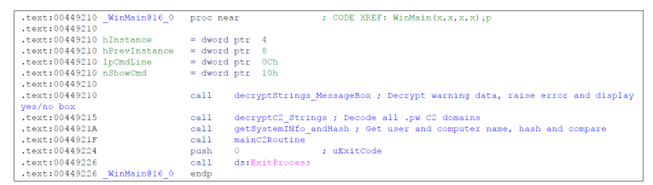
Upon execution, the LummaC2.exe file will enter its main routine, which includes four sub-routines (see Figure 1).
Figure 1. LummaC2 Main Routine
The first routine decrypts strings for a message box that is displayed to the user (see Figure 2).
Figure 2. Message Box
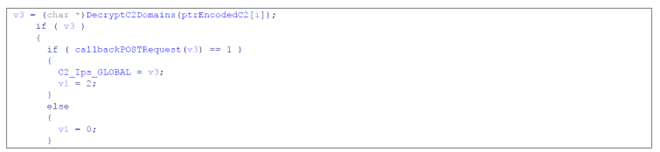
If the user selects No, the malware will exit. If the user selects Yes, the malware will move on to its next routine, which decrypts its callback Command and Control (C2) domains [T1140]. A list of observed domains is included in the Indicators of Compromise section.
After each domain is decoded, the implant will attempt a POST request [T1071.001] (see Figure 3).
Figure 3. Post Request
If the POST request is successful, a pointer to the decoded domain string is saved in a global variable for later use in the main C2 routine used to retrieve JSON formatted commands (see Figure 4).
Figure 4. Code Saving Successful Callback Request
Once a valid C2 domain is contacted and saved, the malware moves on to the next routine, which queries the user’s name and computer name utilizing the Application Programming Interfaces (APIs) GetUserNameW and GetComputerNameW respectively [T1012]. The returned data is then hashed and compared against a hard-coded hash value (see Figure 5).
Figure 5. User and Computer Name Check
The hashing routine was not identified as a standard algorithm; however, it is a simple routine that converts a Unicode string to a 32-bit hexadecimal value.
If the username hash is equal to the value 0x56CF7626, then the computer name is queried. If the computer name queried is seven characters long, then the name is hashed and checked against the hard-coded value of 0xB09406C7. If both values match, a final subroutine will be called with a static value of the computer name hash as an argument. If this routine is reached, the process will terminate. This is most likely a failsafe to prevent the malware from running on the attacker’s system, as its algorithms are one-way only and will not reveal information on the details of the attacker’s own hostname and username.
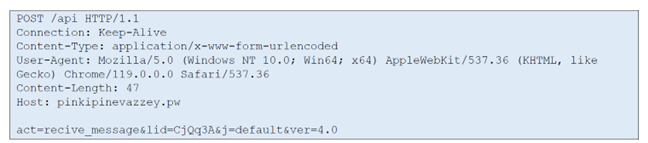
If the username and hostname check function returns zero (does not match the hard-coded values), the malware will enter its main callback routine. The LummaC2 malware will contact the saved hostname from the previous check and send the following POST request (see Figure 6).
Figure 6. Second POST Request
The data returned from the C2 server is encrypted. Once decoded, the C2 data is in a JSON format and is parsed by the LummaC2 malware. The C2 uses the JSON configuration to parse its browser extensions and target lists using the ex key, which contains an array of objects (see Figure 7).
Figure 7. Parsing of ex JSON Value
Parsing the c key contains an array of objects, which will give the implant its C2 (see Figure 8).
Figure 8. Parsing of c JSON Value
C2 Instructions
Each array object that contains the JSON key value of t will be evaluated as a command opcode, resulting in the C2 instructions in the subsections below.
1. Opcode 0 – Steal Data Generic
This command allows five fields to be defined when stealing data, offering the most flexibility. The Opcode O command option allows LummaC2 affiliates to add their custom information gathering details (see Table 1).
Table 2. Opcode 1 Options
Key
Value
p
Path to steal from
m
File extensions to read
z
Output directory to store stolen data
d
Depth of recursiveness
fs
Maximum file size
2. Opcode 1 – Steal Browser Data
This command only allows for two options: a path and the name of the output directory. This command, based on sample configuration downloads, is used for browser data theft for everything except Mozilla [T1217] (see Table 2).
Table 2. Opcode 1 Options
Key
Value
p
Path to steal from
z
Name of Browser – Output
3. Opcode 2 – Steal Browser Data (Mozilla)
This command is identical to Opcode 1; however, this option seems to be utilized solely for Mozilla browser data (see Table 3).
Table 3. Opcode 2 Options
Key
Value
p
Path to steal from
z
Name of Browser – Output
4. Opcode 3 – Download a File
This command contains three options: a URL, file extension, and execution type. The configuration can specify a remote file with u to download and create the extension specified in the ft key [T1105] (see Table 4).
Table 4. Opcode 3 Options
Key
Value
u
URL for Download
ft
File Extension
e
Execution Type
The e value can take two values: 0 or 1. This specifies how to execute the downloaded file either with the LoadLibrary API or via the command line with rundll32.exe [T1106] (see Table 5).
Table 5. Execution Types
Key
Value
e=0
Execute with LoadLibraryW()
e=1
Executive with rund1132.exe
5. Take Screenshot
If the configuration JSON file has a key of “se” and its value is “true,” the malware will take a screenshot in BMP format and upload it to the C2 server.
6. Delete Self
If the configuration JSON file has a key of “ad” and its value is “true,” the malware will enter a routine to delete itself.
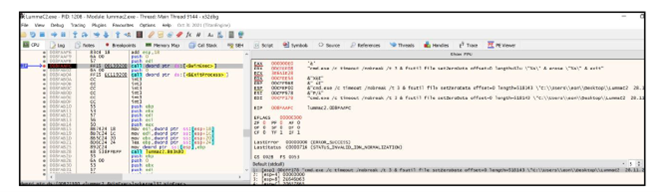
The command shown in Figure 9 will be decoded and executed for self-deletion.
Figure 9. Self-Deletion Command Line
Figure 10 depicts the above command line during execution.
Figure 10. Decoded Command Line in Memory
Host Modifications
Without any C2 interactions, the LummaC2 malware does not create any files on the infected drive. It simply runs in memory, gathers system information, and exfiltrates it to the C2 server [T1082]. The commands returned from the C2 server could indicate that it drops additional files and/or saves data to files on the local hard drive. This is variable, as these commands come from the C2 server and are mutable.
Decrypted Strings
Below is a list of hard-coded decrypted strings located in the binary (see Figure 11).
Figure 11. Decoded Strings
Indicators of Compromise
See Table 6 and Table 7 for LummaC2 IOCs obtained by the FBI and trusted third parties.
Disclaimer: The authoring agencies recommend organizations investigate and vet these indicators of compromise prior to taking action, such as blocking.
Table 6. LummaC2 Executable Hashes
Executables
Type
4AFDC05708B8B39C82E60ABE3ACE55DB (LummaC2.exe from November 2023)
MD5
E05DF8EE759E2C955ACC8D8A47A08F42 (LummaC2.exe from November 2023)
MD5
C7610AE28655D6C1BCE88B5D09624FEF
MD5
1239288A5876C09D9F0A67BCFD645735168A7C80 (LummaC2.exe from November 2023)
SHA1
B66DA4280C6D72ADCC68330F6BD793DF56A853CB (LummaC2.exe from November 2023)
The following are domains observed deploying LummaC2 malware.
Disclaimer: The domains below are historical in nature and may not currently be malicious.
Pinkipinevazzey[.]pw
Fragnantbui[.]shop
Medicinebuckerrysa[.]pw
Musicallyageop[.]pw
stogeneratmns[.]shop
wallkedsleeoi[.]shop
Tirechinecarpet[.]pw
reinforcenh[.]shop
reliabledmwqj[.]shop
Musclefarelongea[.]pw
Forbidstow[.]site
gutterydhowi[.]shop
Fanlumpactiras[.]pw
Computeryrati[.]site
Contemteny[.]site
Ownerbuffersuperw[.]pw
Seallysl[.]site
Dilemmadu[.]site
Freckletropsao[.]pw
Opposezmny[.]site
Faulteyotk[.]site
Hemispheredodnkkl[.]pw
Goalyfeastz[.]site
Authorizev[.]site
ghostreedmnu[.]shop
Servicedny[.]site
blast-hubs[.]com
offensivedzvju[.]shop
friendseforever[.]help
blastikcn[.]com
vozmeatillu[.]shop
shiningrstars[.]help
penetratebatt[.]pw
drawzhotdog[.]shop
mercharena[.]biz
pasteflawwed[.]world
generalmills[.]pro
citywand[.]live
hoyoverse[.]blog
nestlecompany[.]pro
esccapewz[.]run
dsfljsdfjewf[.]info
naturewsounds[.]help
travewlio[.]shop
decreaserid[.]world
stormlegue[.]com
touvrlane[.]bet
governoagoal[.]pw
paleboreei[.]biz
calmingtefxtures[.]run
foresctwhispers[.]top
tracnquilforest[.]life
sighbtseeing[.]shop
advennture[.]top
collapimga[.]fun
holidamyup[.]today
pepperiop[.]digital
seizedsentec[.]online
triplooqp[.]world
easyfwdr[.]digital
strawpeasaen[.]fun
xayfarer[.]live
jrxsafer[.]top
quietswtreams[.]life
oreheatq[.]live
plantainklj[.]run
starrynsightsky[.]icu
castmaxw[.]run
puerrogfh[.]live
earthsymphzony[.]today
weldorae[.]digital
quavabvc[.]top
citydisco[.]bet
steelixr[.]live
furthert[.]run
featureccus[.]shop
smeltingt[.]run
targett[.]top
mrodularmall[.]top
ferromny[.]digital
ywmedici[.]top
jowinjoinery[.]icu
rodformi[.]run
legenassedk[.]top
htardwarehu[.]icu
metalsyo[.]digital
ironloxp[.]live
cjlaspcorne[.]icu
navstarx[.]shop
bugildbett[.]top
latchclan[.]shop
spacedbv[.]world
starcloc[.]bet
rambutanvcx[.]run
galxnetb[.]today
pomelohgj[.]top
scenarisacri[.]top
jawdedmirror[.]run
changeaie[.]top
lonfgshadow[.]live
liftally[.]top
nighetwhisper[.]top
salaccgfa[.]top
zestmodp[.]top
owlflright[.]digital
clarmodq[.]top
piratetwrath[.]run
hemispherexz[.]top
quilltayle[.]live
equatorf[.]run
latitudert[.]live
longitudde[.]digital
climatologfy[.]top
starofliught[.]top
MITRE ATT&CK Tactics and Techniques
See Table 8 through Table 13 for all referenced threat actor tactics and techniques in this advisory. For assistance with mapping malicious cyber activity to the MITRE ATT&CK framework, see CISA and MITRE ATT&CK’s Best Practices for MITRE ATT&CK Mapping and CISA’s Decider Tool.
Threat actors used LummaC2 malware to exfiltrate sensitive user information, including traditional credentials, cryptocurrency wallets, browser extensions, and MFA details without immediate detection.
Threat actors used LummaC2 malware to download files with native OS APIs.
Mitigations
The FBI and CISA recommend organizations implement the mitigations below to reduce the risk of compromise by LummaC2 malware. These mitigations align with the Cross-Sector Cybersecurity Performance Goals (CPGs) developed by CISA and the National Institute of Standards and Technology (NIST). The CPGs provide a minimum set of practices and protections that CISA and NIST recommend all organizations implement. CISA and NIST based the CPGs on existing cybersecurity frameworks and guidance to protect against the most common and impactful threats, tactics, techniques, and procedures. Visit CISA’s CPGs webpage for more information on the CPGs, including additional recommended baseline protections. These mitigations apply to all critical infrastructure organizations.
Separate User and Privileged Accounts: Allow only necessary users and applications access to the registry [CPG 2.E].
Monitor and detect suspicious behavior during exploitation [CPG 3.A].
Monitor and detect suspicious behavior, creation and termination events, and unusual and unexpected processes running.
Monitor API calls that may attempt to retrieve system information.
Analyze behavior patterns from process activities to identify anomalies.
Implement application controls to manage and control execution of software, including allowlisting remote access programs. Application controls should prevent installation and execution of portable versions of unauthorized remote access and other software. A properly configured application allowlisting solution will block any unlisted application execution. Allowlisting is important because antivirus solutions may fail to detect the execution of malicious portable executables when the files use any combination of compression, encryption, or obfuscation.
Log Collection: Regularly monitoring and reviewing registry changes and access logs can support detection of LummaC2 malware [CPG 2.T].
Implement authentication, authorization, and accounting (AAA) systems [M1018] to limit actions users can perform and review logs of user actions to detect unauthorized use and abuse. Apply principles of least privilege to user accounts and groups, allowing only the performance of authorized actions.
Audit user accounts and revoke credentials for departing employees, removing those that are inactive or unnecessary on a routine basis [CPG 2.D]. Limit the ability for user accounts to create additional accounts.
Keep systems up to date with regular updates, patches, hot fixes, and service packs that may minimize vulnerabilities. Learn more by visiting CISA’s webpage: Secure our World Update Software.
Secure network devices to restrict command line access.
Use segmentation to prevent access to sensitive systems and information, possibly with the use of Demilitarized Zone (DMZ) or virtual private cloud (VPC) instances to isolate systems [CPG 2.F].
Monitor and detect API usage, looking for unusual or malicious behavior.
Validate Security Controls
In addition to applying mitigations, the FBI and CISA recommend exercising, testing, and validating your organization’s security program against threat behaviors mapped to the MITRE ATT&CK Matrix for Enterprise framework in this advisory. The FBI and CISA recommend testing your existing security controls inventory to assess performance against the ATT&CK techniques described in this advisory.
To get started:
Select an ATT&CK technique described in this advisory (see Table 8 through Table 13).
Align your security technologies against the technique.
Test your technologies against the technique.
Analyze your detection and prevention technologies’ performance.
Repeat the process for all security technologies to obtain a set of comprehensive performance data.
Tune your security program, including people, processes, and technologies, based on the data generated by this process.
The FBI and CISA recommend continually testing your security program, at scale, in a production environment to ensure optimal performance against the MITRE ATT&CK techniques identified in this advisory.
Reporting
Your organization has no obligation to respond or provide information to the FBI in response to this joint advisory. If, after reviewing the information provided, your organization decides to provide information to the FBI, reporting must be consistent with applicable state and federal laws.
The FBI is interested in any information that can be shared, to include the status and scope of infection, estimated loss, date of infection, date detected, initial attack vector, and host- and network-based indicators.
To report information, please contact the FBI’s Internet Crime Complaint Center (IC3), your local FBI field office, or CISA’s 24/7 Operations Center at report@cisa.gov or (888) 282-0870.
Disclaimer
The information in this report is being provided “as is” for informational purposes only. The FBI and CISA do not endorse any commercial entity, product, company, or service, including any entities, products, or services linked within this document. Any reference to specific commercial entities, products, processes, or services by service mark, trademark, manufacturer, or otherwise, does not constitute or imply endorsement, recommendation, or favor by the FBI and CISA.
This advisory details the tactics, techniques, and procedures, and indicators of compromise (IOCs) linked to threat actors deploying LummaC2 malware. This malware poses a serious threat, capable of infiltrating networks and exfiltrating sensitive information, to vulnerable individuals’ and organizations’ computer networks across U.S. critical infrastructure sectors.
As recently as May 2025, threat actors have been observed using LummaC2 malware, underscoring the ongoing threat. The advisory includes IOCs tied to infections from November 2023 through May 2025. Organizations are strongly urged to review the advisory and implement the recommended mitigations to reduce exposure and impact.